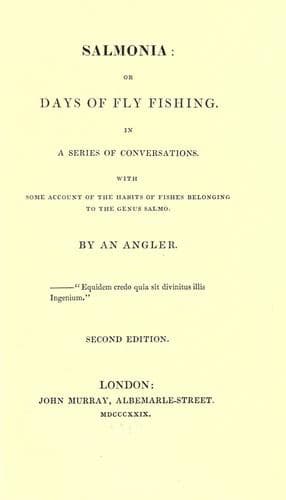
Salmonia; Or, Days of Fly Fishing: In a series of conversations. With some account of the habits of fishes belonging to the genus SalmoDavy, Humphry, Sir
Philosophy
Salmonia; Or, Days of Fly Fishing: In a series of conversations. With some account of the habits of fishes belonging to the genus Salmo
Davy, Humphry, Sir
Fishing
the principle, not only of perfection, but likewise of conservation, is
found, marking a species of intelligence and power which can be compared
to nothing human. The first created swarm of bees contained beings
provided with all the instincts necessary for the perpetual continuance
of the species; and some of these instincts can scarcely be understood
by man, requiring the most profound geometrical knowledge, even to
calculate their results; and _other instincts_ involve what in human
society would be the most singular state of policy, combining contrasted
moral causes and contradictory interests. It is impossible not to be
lost in awe at the contemplation of this chain of facts; the human mind
cannot fail to acknowledge in them the strongest proofs of their being
produced by infinite wisdom and unbounded power; and the devout
philosopher can scarcely avoid considering with respect a little insect,
endowed with faculties producing combinations, which human reason vainly
attempts to imitate, and can scarcely understand.
PHYS.—I agree with you, that if instinct be supposed the result of
organization, and that the first animal types were so created as to
transmit their instincts invariably, generation after generation, it
does offer a most triumphant and incontrovertible argument for the
existence of an all-powerful intelligent Cause.—Even in the instance
which led to this conversation, the instinct which carries salmon from
the sea to the sources of rivers, it is only lately philosophers have
discovered, that the impregnated eggs cannot produce young fishes
independent of the influence of air; and thus an animal goes many
hundred miles under the direction of an instinct, the use of which human
reason has at length developed, and man is supplied with an abundant
food by the result of a combination, in consequence of which a species
is preserved.
POIET.—I do not understand, Halieus, your objections to the view I have
adopted, which is sanctioned by the authority of a good ethic
philosopher, Addison. Allowing the omnipresence and constant power of
Deity, I do not see how you can avoid admitting his actual interference
in all the phenomena of living nature.
HAL.—As I said before, I cannot _confute_ your view; but, upon this
principle, gravitation and the motion of the planets round the sun, and
all the other physical phenomena of the universe, would be owing to the
immediate action of the Divinity. I prefer the view, which refers them
to motion and properties, the results of general laws impressed on
matter by Omnipotence. This view is, I think, simpler; but it is
difficult to form any distinct opinion on so high and incomprehensible a
subject, on which, perhaps, after all, it is wiser to confess our entire
ignorance, and to bow down in humble adoration to the one
incomprehensible Cause of all being.
Public-domain text, read in full here on John Shaqi.
Reviews
Reviews
No reviews yet
Be the first to share your thoughts on this work.
Elsewhere in the archive
Join the Discussion
Join the discussion
Sign in to leave a comment or review.
Sign InorCreate an account