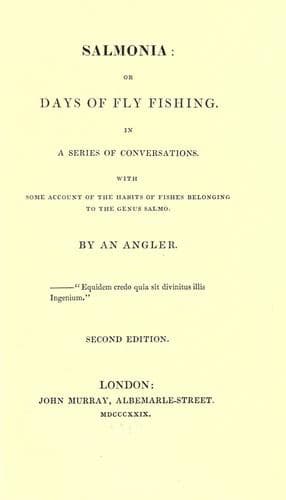
Salmonia; Or, Days of Fly Fishing: In a series of conversations. With some account of the habits of fishes belonging to the genus SalmoDavy, Humphry, Sir
Philosophy
Salmonia; Or, Days of Fly Fishing: In a series of conversations. With some account of the habits of fishes belonging to the genus Salmo
Davy, Humphry, Sir
Fishing
HAL.—That instincts depend upon impulses immediately derived from the
Deity is an opinion which, though it perhaps cannot be confuted, yet
does not please me so much as to believe them dependent upon the
formation of organs, and the result of the general laws which govern the
system of the universe; and it is in favour of this opinion that they
are susceptible of modifications. Thus, in domesticated animals they are
always changed; the turkey and the duck lose their habits of
constructing nests, and the goose does not migrate. In supposing them
the result of organization and hereditary, they might be expected to be
changed by circumstances, as they are actually found to be. Without
referring the instincts of animals to the immediate impulse of the
Deity, they appear to me to offer the most irresistible and convincing
argument that can be brought forward against atheism. They demonstrate
combinations, the result of the most refined intelligence, which can
only be considered as infinite. Take any one of the lowest class of
animals, insects for instance, not only is their organization fitted to
all their wants; but their association in society is provided for, and
the laws of a perfect social community, as it were, are adopted by
beings, that we are sure cannot reason. In the hive bee, for instance,
the instinct of the workers leads them to adopt and obey a queen; and if
she is taken away from them, or dies, they have the power of raising
another from offspring in the cells by an almost miraculous process:
they work under her government for a common object, allow males only to
exist for the purpose of impregnating females, who preserve the society,
and under whose government they send forth swarms, which readily place
themselves under the protection of man. In the geometrical construction
of their cells, the secretion of wax from their bodies, the collecting
their food, and the care of the brood, there is a series of results
which it requires a strong reason to follow, and which are the
consequences of invariable instincts. Bees, since they have been noticed
by naturalists, have the same habits, and, as it is probable that there
have been many thousand of generations since the creation, it is
evident, that the instincts of the first bees have been hereditary and
invariable in their offspring; and it cannot be doubted, that they do
now, as they did four thousand years ago, make some cells in combs
larger than others for the purpose of containing the eggs and future
grubs of drones, that are to be produced by a grub, which they are
educating for a queen bee; and that these cells are connected with the
common cells by a series, in which the most exact geometrical laws of
transition are observed. An eminent philosopher has deduced an argument
in favour of the existence of Deity from the analogy of the universe to
a piece of mechanism, which could only be the work of an intelligent
mind; but there is this difference: in all the productions of nature,
Public-domain text, read in full here on John Shaqi.
Reviews
Reviews
No reviews yet
Be the first to share your thoughts on this work.
Elsewhere in the archive
Join the Discussion
Join the discussion
Sign in to leave a comment or review.
Sign InorCreate an account