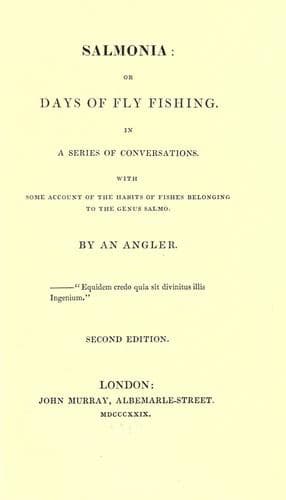
Salmonia; Or, Days of Fly Fishing: In a series of conversations. With some account of the habits of fishes belonging to the genus SalmoDavy, Humphry, Sir
Philosophy
Salmonia; Or, Days of Fly Fishing: In a series of conversations. With some account of the habits of fishes belonging to the genus Salmo
Davy, Humphry, Sir
Fishing
HAL.—Swallows follow the flies and gnats, and flies and gnats usually
delight in warm strata of air; and as warm air is lighter, and usually
moister, than cold air, when the warm strata of air are high, there is
less chance of moisture being thrown down from them by the mixture with
cold air; but when the warm and moist air is close to the surface, it is
almost certain, that, as the cold air flows down into it, a deposition
of water will take place.
POIET.—I have often seen sea-gulls assemble on the land, and have almost
always observed, that very stormy and rainy weather was approaching. I
conclude, that these animals, sensible of a current of air approaching
from the ocean, retire to the land to shelter themselves from the storm.
ORN.—No such thing. The storm is their element; and the little petrel
enjoys the heaviest gale, because, living on the smaller sea insects, he
is sure to find his food in the spray of a heavy wave—and you may see
him flitting above the edge of the highest surge. I believe, that the
reason of this migration of seagulls, and other sea birds, to the land,
is their security of finding food. They may be observed, at this time,
feeding greedily on the earth worms and larvæ, driven out of the ground
by severe floods; and the fish, on which they prey in fine weather in
the sea, leave the surface, when storms prevail and go deeper. The
search after food, as we agreed on a former occasion, is the principal
cause why animals change their places. The different tribes of the
wading birds always migrate when rain is about to take place; and I
remember once, in Italy, having been long waiting, in the end of March,
for the arrival of the double snipe in the Campagna of Rome,—a great
flight appeared on the 3d of April, and the day after heavy rain set in,
which greatly interfered with my sport. The vulture, upon the same
principle, follows armies; and I have no doubt, that the augury of the
ancients was a good deal founded upon the observation of the instincts
of birds. There are many superstitions of the vulgar owing to the same
source. For anglers, in spring, it is always unlucky to see single
magpies,—but _two_ may be always regarded as a favourable omen; and the
reason is, that in cold and stormy weather one magpie alone leaves the
nest in search of food, the other remaining sitting upon the eggs or the
young ones; but when two go out together, the weather is warm and mild,
and thus favourable for fishing.
Public-domain text, read in full here on John Shaqi.
Reviews
Reviews
No reviews yet
Be the first to share your thoughts on this work.
Elsewhere in the archive
Join the Discussion
Join the discussion
Sign in to leave a comment or review.
Sign InorCreate an account