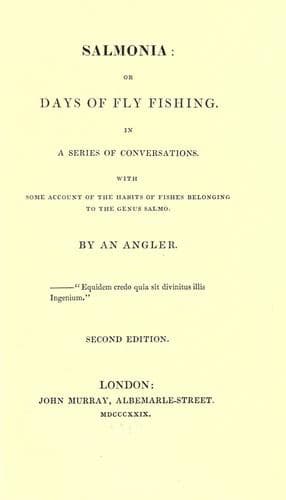
Salmonia; Or, Days of Fly Fishing: In a series of conversations. With some account of the habits of fishes belonging to the genus SalmoDavy, Humphry, Sir
Philosophy
Salmonia; Or, Days of Fly Fishing: In a series of conversations. With some account of the habits of fishes belonging to the genus Salmo
Davy, Humphry, Sir
Fishing
example of De Geer, Reaumur, and Huber, and study minutely the habits of
particular tribes; and it is probable, that physiology might be much
advanced by minutely investigating the simplest forms of living beings;
and that particularly with respect to the functions of generation a
minute study of the modifications of which the forms of animals seems
susceptible, particularly in the hymenopterous, or bee tribe, might lead
to very important results.
POIET.—Even in a moral point of view, I think the analogies derived from
the transformation of insects admit of some beautiful applications, that
have not been neglected by pious entomologists. The three states—of the
caterpillar, pupa, or aurelia, and butterfly—have, since the time of the
Greek poets, been applied to typify the human being—its terrestrial
form, apparent death, and ultimate celestial destination; and it seems
more extraordinary that a sordid and crawling worm should become a
beautiful and active fly—that an inhabitant of the dark and fœtid
dunghill should in an instant entirely change its form, rise into the
blue air, and enjoy the sunbeams,—than that a being, whose pursuits here
have been after an undying name, and whose purest happiness has been
derived from the acquisition of intellectual power and finite knowledge,
should rise hereafter into a state of being, where immortality is no
longer a name, and ascend to the source of Unbounded Power and Infinite
Wisdom.
PHYS.—I have been listening, Halieus, to your account of water-flies
with attention, and I only regret, that your details were not more
copious; let me now call your attention to that Michaelmas daisy. A few
minutes ago, before the sun sunk behind the hill, its flowers were
covered with varieties of bees, and some wasps, all busy in feeding on
its sweets. I never saw a more animated scene of insect enjoyment. The
bees were most of them humble bees, but many of them some new varieties
to me, and the wasps appeared different from any I have seen before.
HAL.—I believe this is one of the last autumnal flowers that insects of
this kind haunt. In sunny days it is their constant point of resort, and
it would afford a good opportunity to the entomologist to make a
collection of British bees.
POIET.—I neither hear the hum of the bee, nor can I see any on its
flowers. They are now deserted.
PHYS.—Since the sun has disappeared, the cool of the evening has, I
suppose, driven the little winged plunderers to their homes; but see,
there are two or three humble bees which seem languid with the cold, and
yet they have their tongues still in the fountain of honey. I believe
one of them is actually dead, yet his mouth is still attached to the
flower. He has fallen asleep, and probably died whilst making his last
meal of ambrosia.
ORN.—What an enviable destiny, quitting life in the moment of enjoyment,
following an instinct, the gratification of which has been always
pleasurable! so beneficent are all the laws of Divine Wisdom.
Public-domain text, read in full here on John Shaqi.
Reviews
Reviews
No reviews yet
Be the first to share your thoughts on this work.
Elsewhere in the archive
Join the Discussion
Join the discussion
Sign in to leave a comment or review.
Sign InorCreate an account