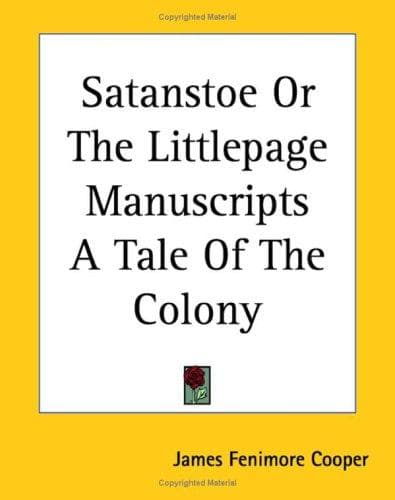
Satanstoe; Or, the Littlepage Manuscripts. A Tale of the ColonyCooper, James Fenimore
General
Satanstoe; Or, the Littlepage Manuscripts. A Tale of the Colony
Cooper, James Fenimore
Antirent War, N.Y., 1839-1846 -- Fiction
“Your servant, Mr. Littlepage; your servant, Mr. Follock,” he cried, again
shaking each cordially by the hand. “I was on the way to the tavern to
look you up, when I accidentally saw you here. A few gentlemen of my
acquaintance, who are in the habit of supping together in the winter time,
meet for the last jollification of the season to-night, and they have all
express't a wish to have the pleasure of your company. I hope you will
allow me to say you will come? We meet at nine, sup at ten, and break up at
twelve, quite regularly, in a very sedate and prudent manner.”
There was something so frank and cordial, so simple and straight-forward in
this invitation, that we did not know how to decline it. We both knew that
the name of Ten Eyck was respectable in the colony; our new acquaintance
was well dressed, he seemed to be in good company when we first met him,
his sleigh and horses had been actually of a more dashing stamp than usual,
and his own attire had all the peculiarities of a gentleman's, with the
addition of something even more decided and knowing than was common. It is
true, the style of these peculiarities was not exactly such as I had seen
in the air, manners and personal decorations of those of Billings and
Harris; but they were none the less striking, and none the less attractive;
the two Englishmen being “macaronis,” from London, and Ten Eyck being a
“buck” of Albany.
“I thank you, very heartily, Mr. Ten Eyck,” I answered, “both for myself
and for my friend”--
“And will let me come for you at half-past eight, to show you the way?”
“Why, yes, sir; I was about to say as much, if it be not giving you too
much trouble.”
“Do not speak of tr-r-ouple”--this last word will give a very good
notion of Guert's accent, which I cannot stop to imitate at all times in
writing--“and do not say your _fre'nt_, but your _fre'ntz_.”
“As to the two that are not here, I cannot positively answer; yonder,
however, is one that can speak for himself.”
“I see him, Mr. Littlepage, and will answer for _him_, on my own account.
Depent on it, _he_ will come. But the Dominie--he has a hearty look, and
can help eat a turkey and swallow a glass of goot Madeira--I think I can
rely on. A man cannot take all that active exercise without food.”
“Mr. Worden is a very companionable man, and is excellent company at a
supper-table. I will communicate your invitation, and hope to be able to
prevail on him to be of the party.”
“T'at is enough, sir,” returned Ten Eyck, or Guert, as I shall henceforth
call him, in general; “vere dere ist a vill, dere ist a vay.” Guert
frequently broke out in such specimens of broken English, while at other
times he would speak almost as well as any of us. “So Got pless you my dear
Mr. Littlepage, and make us lasting friends. I like your countenance, and
my eye never deceives me in these matters.”
Public-domain text, read in full here on John Shaqi.
Reviews
Reviews
No reviews yet
Be the first to share your thoughts on this work.
Elsewhere in the archive
Join the Discussion
Join the discussion
Sign in to leave a comment or review.
Sign InorCreate an account