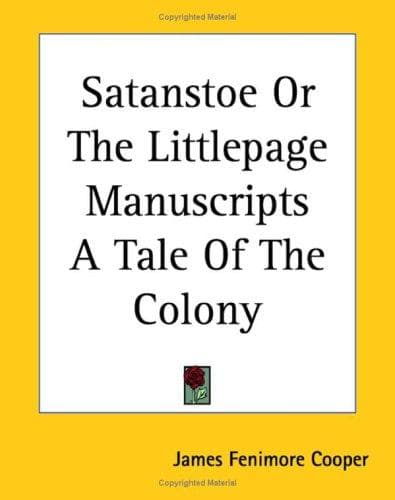
Satanstoe; Or, the Littlepage Manuscripts. A Tale of the ColonyCooper, James Fenimore
General
Satanstoe; Or, the Littlepage Manuscripts. A Tale of the Colony
Cooper, James Fenimore
Antirent War, N.Y., 1839-1846 -- Fiction
I have said that the night had a sombre, misty, light, the moon wading
across the heavens through a deep but thin ocean of vapour. We saw the
shores plainly enough, and we saw the houses and trees, but it was
difficult to distinguish smaller objects at any distance. In the course of
the day twenty sleighs had been met or passed, but at that hour everybody
but ourselves appeared to have deserted the river. It was getting late for
the simple habits of those who dwelt on its shores. When about half-way
between the islands opposite to Coejeman's and the hamlet just named,
Guert, who stood erect to drive, told us that some one who was out late,
like themselves, was coming down. The horses of the strangers were in a
very fast trot, and the sleigh was evidently inclining towards the west
shore, as if those it held intended to land at no great distance. As it
passed, quite swiftly, a man's voice called out something on a high key,
but our bells made so much noise that it was not easy to understand him. He
spoke in Dutch, too, and none of our ears, those of Guert excepted,
were sufficiently expert in that language to be particularly quick in
comprehending what he said. The call passed unheeded, then, such things
being quite frequent among the Dutch, who seldom passed each other on the
highway without a greeting of some sort or other. I was thinking of this
practice, and of the points that distinguished our own habits from those of
the people of this part of the colony, when sleigh-bells sounded quite near
me, and turning my head, I saw Herman Mordaunt's bays galloping close to
us, as if wishing to get alongside. At the next moment the object was
effected, and Guert pulled up.
“Did you understand the man who passed down, Guert?” demanded Herman
Mordaunt, as soon as all noises ceased.
“He called out to us, at the top of his voice, and would hardly do that
without an object.”
“These men seldom go home, after a visit to Albany, without filling their
jugs,” answered Guert, drily; “what could he have to say, more than to wish
us good-night?”
“I cannot tell, but Mrs. Bogart thought she understood something about
'Albany,' and 'the river.'”
“The ladies always fancy Albany is to sink into the river after a great
thaw,” answered Guert, good-humouredly; “but I can show either of them that
the ice is sixteen inches thick, here where we stand.”
Guert then gave me the reins, stepped out of the sleigh, went a short
distance to a large crack that he had seen while speaking, and returned
with a thumb placed on the handle of the whip, as a measure to show that
his statement was true. The ice, at that spot, was certainly nearer
eighteen than sixteen inches thick. Herman Mordaunt showed the measure
to Mrs. Bogart, whose alarm was pacified by this positive proof. Neither
Anneke nor Mary exhibited any fear; but, on the contrary, as the sleighs
separated again, each had something pleasant, but feminine, to say at the
expense of poor Mrs. Bogart's imagination.
Public-domain text, read in full here on John Shaqi.
Reviews
Reviews
No reviews yet
Be the first to share your thoughts on this work.
Elsewhere in the archive
Join the Discussion
Join the discussion
Sign in to leave a comment or review.
Sign InorCreate an account