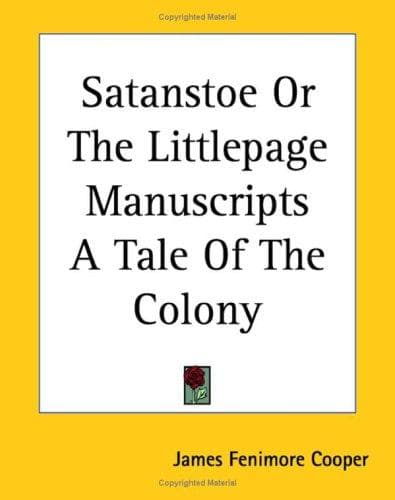
Satanstoe; Or, the Littlepage Manuscripts. A Tale of the ColonyCooper, James Fenimore
General
Satanstoe; Or, the Littlepage Manuscripts. A Tale of the Colony
Cooper, James Fenimore
Antirent War, N.Y., 1839-1846 -- Fiction
“It refers to the father; and, I can tell you, my fine fellow, that fathers
are of some account, in the arrangement of marriages between parties of any
standing. Had not Sir Harry authorized my own proposals, where should I
have been? Not a farthing of settlement could I have offered, while he
remained Sir Harry; notwithstanding I had the prodigious advantage of the
entail. I can tell you what it is, Corny; the existing power is always an
important power since we all think more of the present time, than of the
future. That is the reason so few of us get to Heaven. As for Herman
Mordaunt, I deem it no more than fair to tell you, he is on my side, heart
and hand. He likes my offers of settlement; he likes my family; he likes my
rank, civil and military; and I am not altogether without the hope, that he
likes _me_.”
I made no direct answer, and the conversation soon changed. Bulstrode's
declaration, however, caused me to remember both the speech and manner of
Herman Mordaunt, when he thanked me for saving his daughter's life. I
now began to reflect on it; and reflected on it much during the next
few months. In the end, the reader will learn the effect it had on my
happiness.
CHAPTER XVIII.
“Good Sir, why do you start; and seem to fear
Things that do sound so fair? I' the name of truth,
Are ye fantastical, or that indeed
Which outwardly ye show?”
_Banquo_.
As I have said already, the adventure on the river made a good deal of
noise, in that simple community; and it had the effect to render Guert and
myself a sort of heroes, in a small way; bringing me much more into
notice, than would otherwise have been the case. I thought that Guert,
in particular, would be likely to reap its benefit; for, various elderly
persons, who were in the habit of frowning, whenever his name was
mentioned, I was given to understand, could now smile; and two or three of
the most severe among the Albany moralists, were heard to say that, “after
all, there was some good about that Guert Ten Eyck.” The reader will not
require to be told, that a high-school moralist, in a place as retired and
insulated as Albany, must necessarily be a being that became subject to a
very severe code. Morality, as I understand the matter, has a good deal of
convention about it. There is town-morality and country-morality, all over
the world, as they tell me. But, in America, our morals were, and long
have been, separated into three great and very distinct classes; viz.--New
England, or puritan-morals; middle colonies, or liberal morals; and
southern colonies, or latitudinarian morals. I shall not pretend to point
out all the shades of difference in these several schools; though that in
which I had myself been taught, was necessarily the most in conformity with
my own tastes. There were minor shades to be found in the same school;
Guert and myself belonging to different classes. His morals were of the
Dutch class; while mine more properly belonged to the English. The great
Public-domain text, read in full here on John Shaqi.
Reviews
Reviews
No reviews yet
Be the first to share your thoughts on this work.
Elsewhere in the archive
Join the Discussion
Join the discussion
Sign in to leave a comment or review.
Sign InorCreate an account