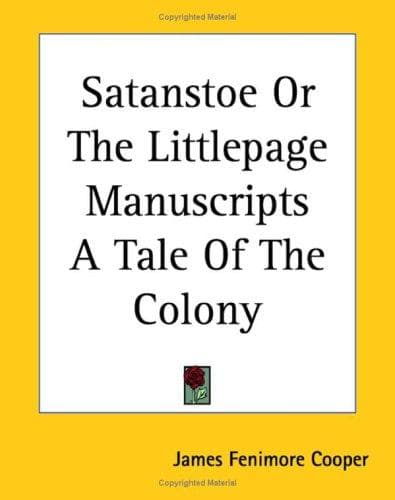
Satanstoe; Or, the Littlepage Manuscripts. A Tale of the ColonyCooper, James Fenimore
General
Satanstoe; Or, the Littlepage Manuscripts. A Tale of the Colony
Cooper, James Fenimore
Antirent War, N.Y., 1839-1846 -- Fiction
Herman Mordaunt then spoke more fully of his own plans for the
summer--expressed his happiness at knowing that Dirck and myself were to be
what he called his neighbours--though, on a more exact computation, it
was ascertained, that the nearest boundaries of the two patents, that of
Ravensnest, and that of Mooseridge, lay quite fourteen miles apart, with a
dense and virgin forest between them. Nevertheless, this would be making us
neighbours, in a certain sense; as gentlemen always call men of their own
class neighbours, when they live within visiting distance, or near enough
to be seen once or twice in a year. And such men _are_ neighbours, in the
sense that is most essential to the term--they know each other better;
understand each other better; sympathize more freely; have more of the
intercourse that makes us judges of motives, principles, and character,
twenty-fold, than he who lives at the gate, and merely sees the owner of
the grounds pass in and out, on his daily avocations. There is, and can
be no greater absurdity, than to imagine that the sheer neighbourhood,
or proximity of position, makes men acquainted. That was one of Jason
Newcome's Connecticut notions. Having been educated in a state of society
in which all associated on a certain footing of intimacy, and in which half
the difficulties that occurred were “told to the church,” he was for ever
fancying he knew all the gentry of Westchester, because he had lived a year
or two in the county; when, in fact, he had never spoken to one in a dozen
of them. I never could drive this notion out of his head, however; for
_looking_ often at a man, or occasionally exchanging a bow with him on the
highway, he would insist was knowing him, or what he called, being “well
acquainted;” a very favourite expression of the Danbury man's; though their
sympathies, habits, opinions, and feelings, created so vast a void between
the parties, they hardly understood each other's terms, and ordinary
language, when they did begin to converse, as sometimes happened.
Notwithstanding all this, Jason insisted to the last that he _knew_ every
gentleman in the county, whom he had been accustomed to hear alluded to in
discourse, and when he had seen them once or twice, though it were only
at church. But Jason had a very flattering notion, generally, of his own
acquisitions on all subjects.
Public-domain text, read in full here on John Shaqi.
Reviews
Reviews
No reviews yet
Be the first to share your thoughts on this work.
Elsewhere in the archive
Join the Discussion
Join the discussion
Sign in to leave a comment or review.
Sign InorCreate an account