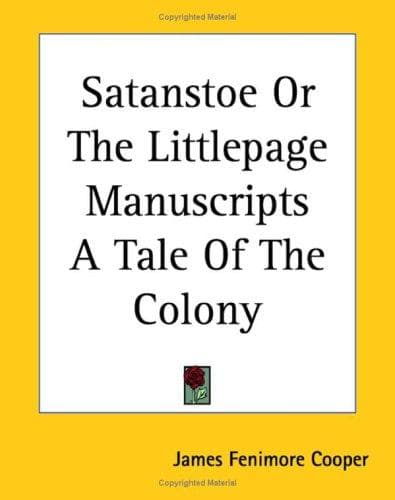
Satanstoe; Or, the Littlepage Manuscripts. A Tale of the ColonyCooper, James Fenimore
General
Satanstoe; Or, the Littlepage Manuscripts. A Tale of the Colony
Cooper, James Fenimore
Antirent War, N.Y., 1839-1846 -- Fiction
As for us men, buckskin formed the principal material of our garments.
We all wore buckskin breeches, and gaiters, and moccasins. The latter,
however, had the white-man's soles; though Guert took a pair or two with
him that were of the pure Indian manufacture. Each of us had a coatee, made
of common cloth; but we all carried hunting-shirts, to be worn as soon as
we entered the woods. These hunting-shirts, green in colour, fringed and
ornamented garments, of the form of shirts to be worn over all, were
exceedingly smart in appearance, and were admirably suited to the woods. It
was thought that the fringes, form, and colour, blended them so completely
with the foliage, as to render them in a manner invisible to one at a
distance; or at least, undistinguished. They were much in favour with all
the forest corps of America, and formed the usual uniform of the riflemen
of the woods, whether acting against man, or only against the wild beasts.
Neither Mr. Worden, nor Jason, moved with the main party; and it was
precisely on account of these distinctions of dress. As for the divine, he
was so good a stickler for appearances, he would have worn the gown
and surplice, even on a mission to the Indians; which, by-the-way, was
ostensibly his present business; and, at the several occasions, on which I
saw him at cock-fights, he kept on the clerical coat and shovel-hat. In a
word, Mr. Worden never neglected externals, so far as dress was concerned;
and, I much question, if he would have consented to read prayers without
the surplice, or to preach without the gown, let the desire for spiritual
provender be as great as it might. I very well remember to have heard my
father say, that, on one occasion, the parson had refused to officiate of
a Sunday, when travelling, rather than bring discredit on the church, by
appearing in the discharge of his holy office, without the appliances that
belonged to the clerical character.
“More harm than good is done to religion, Mr. Littlepage,” said the Rev.
Mr. Worden, on that occasion, “by thus lessening its rites in vulgar eyes.
The first thing is to teach men to respect holy things, my dear sir; and a
clergyman in his gown and surplice, commands threefold the respect of one
without them. I consider it, therefore, a sacred duty to uphold the dignity
of my office on all occasions.”
It was in consequence of these opinions, that the divine travelled in his
clerical hat, clerical coat, black breeches, and band, even when in pursuit
of the souls of red men among the wilds of North America! I will not take
it upon myself to say, these observances had not their use; but I am very
certain they put the reverend gentleman to a great deal of inconvenience.
Public-domain text, read in full here on John Shaqi.
Reviews
Reviews
No reviews yet
Be the first to share your thoughts on this work.
Elsewhere in the archive
Join the Discussion
Join the discussion
Sign in to leave a comment or review.
Sign InorCreate an account