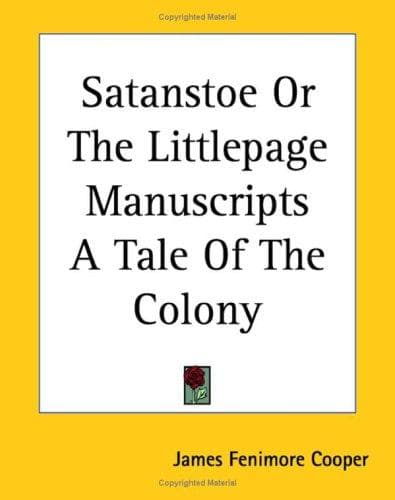
Satanstoe; Or, the Littlepage Manuscripts. A Tale of the ColonyCooper, James Fenimore
General
Satanstoe; Or, the Littlepage Manuscripts. A Tale of the Colony
Cooper, James Fenimore
Antirent War, N.Y., 1839-1846 -- Fiction
The house formed three sides of a parallelogram, the open portion of the
court in the centre, facing the cliff. A strong picket served to make a
defence against bullets on that side; while the dead walls of solid logs
were quite impregnable against any assault known in forest warfare, but
that of fire. All the windows opened on the court; while the single outer
door was picketed, and otherwise protected by the coverings of plank. I was
glad to see by the extent of this rude structure, which was a hundred feet
long by fifty in depth, that Anneke and Mary Wallace would not be likely to
be straitened for room. Such proved to be the fact; Herman Mordaunt's agent
having prepared four or five apartments for the family, that rendered them
as comfortable as people could well expect to be in such a situation.
Everything was plain, and many things were rude; but shelter, warmth and
security had not been neglected.
[Footnote 32: The ordinary American reader may not know that the rank
of Brigadier, in the British army, is not a step in the regular line of
promotion, as with us. In England, the regular military gradations are from
Colonel to Major-general, Lieut. General, General, and Field Marshal. The
rank of Brigadier is barely recognised, like that of Commodore, in the
navy, to be used on emergencies; usually as brevet, _local_ rank, to enable
the government to employ clever colonels at need.]
[Footnote 33: The late venerable Hendrick Frey was a man well known to all
who dwelt in the valley of the Mohawk. He had been a friend, contemporary,
and it is believed an executor of the celebrated Sir William Johnson, Bart.
Thirty years since, he related to the writer the following anecdote. Young
Johnson first appeared in the valley as the agent of a property belonging
to his kinsman, Admiral Sir Peter Warren, K. B.; who, having married in
the colony, had acquired several estates in it. Among other tracts was one
called Warrens-bush, on the Mohawk, on which young Johnson first resided.
Finding it difficult to get rid of the trees around his dwelling, Johnson
sent down to the admiral, at New York, to provide some purchases with which
to haul the trees down to the earth, after grubbing and cutting the roots
on one side. An acre was lowered in this manner, each tree necessarily
lying at a larger angle to the earth than the next beneath it. An easterly
wind came one night, and, to Johnson's surprise, he found half his trees
erect again, on rising in the morning! The mode of clearing lands by
'purchases' was then abandoned.--EDITOR.]
CHAPTER XXI.
“And long shall timorous fancy see
The painted chief and pointed spear;
And Reason's self shall bow the knee
To shadows and delusions here.”
FRENEAU.
Public-domain text, read in full here on John Shaqi.
Reviews
Reviews
No reviews yet
Be the first to share your thoughts on this work.
Elsewhere in the archive
Join the Discussion
Join the discussion
Sign in to leave a comment or review.
Sign InorCreate an account