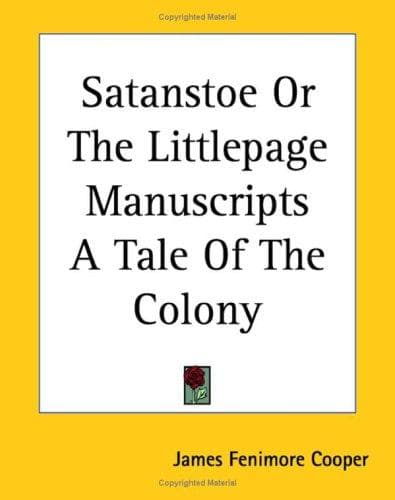
Satanstoe; Or, the Littlepage Manuscripts. A Tale of the ColonyCooper, James Fenimore
General
Satanstoe; Or, the Littlepage Manuscripts. A Tale of the Colony
Cooper, James Fenimore
Antirent War, N.Y., 1839-1846 -- Fiction
All this was making no more than one of the common log-houses of the new
settlements, though in a more hurried and a less artificial manner than was
usual. We had no chimney, for our cooking could be done in the open air;
and less attention was paid to the general finish of the work, than might
have been the case had we expected to pass the winter there. The floor was
somewhat rude, but it had the effect of raising us from the ground, and
giving us perfectly dry lodgings; an advantage not always obtained in the
woods. It was composed of logs roughly squared on three sides, and placed
on sleepers. To my surprise, Traverse directed a door to be made of riven
logs, that were pinned together with cross-pieces, and which was hung
on the usual wooden hinges. When I spoke of this as unnecessary labour,
occupying two men an entire day to complete, he reminded me that we were
much in advance from the settlements; that an active war was being waged
around us, and that the agents of the French had been very busy among our
own tribes, while those in Canada often pushed their war-parties far within
our borders. He had always found a great satisfaction, as well as security,
in having a sort of citadel to retreat to, when on these exposed surveys;
and _he_ never neglected the necessary precaution, when he fancied himself
in the least danger.
We were quite a week in completing our house; though, after the first day,
neither the surveyor nor his chain-bearers troubled themselves with the
labour, any further than to make an occasional suggestion. Traverse and his
men went to work in their own pursuit, running lines to divide the patent
into its great lots, each of which was made to contain a thousand acres.
It should be mentioned that all the surveys, in that day, were made on the
most liberal scale, our forty thousand acres turning out, in the end, to
amount to quite three thousand more. So it was with the subdivisions of the
Patent, each of which was found to be of more than the nominal dimensions.
Blazed trees, and records cut into the bark, served to indicate the lines,
while a map went on _pari passu_ with the labour, the field-book containing
a description of each lot, in order that the proprietor of the estate might
have some notions of the nature of its soil and surface, as well as of the
quality and sizes of the trees it bore.
Public-domain text, read in full here on John Shaqi.
Reviews
Reviews
No reviews yet
Be the first to share your thoughts on this work.
Elsewhere in the archive
Join the Discussion
Join the discussion
Sign in to leave a comment or review.
Sign InorCreate an account