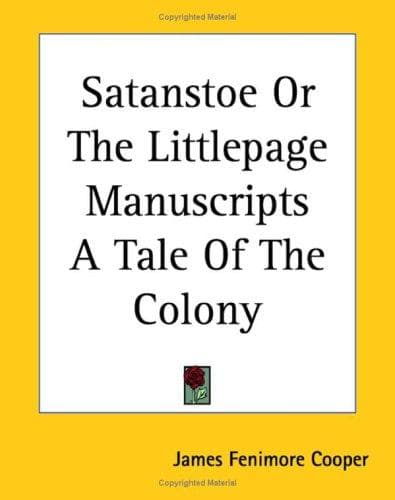
Satanstoe; Or, the Littlepage Manuscripts. A Tale of the ColonyCooper, James Fenimore
General
Satanstoe; Or, the Littlepage Manuscripts. A Tale of the Colony
Cooper, James Fenimore
Antirent War, N.Y., 1839-1846 -- Fiction
“There may be truth in _that_--more than in the report that the woods are
full of savages. It is usually a bad sign when an Indian quits his tribe;
and this runner of ours is certainly an Onondago; _that_ I know, for the
fellow has twice refused rum. Bread he will take, as often as offered; but
rum has not wet his lips, since I have seen him, offered in fair weather or
foul.”
“T'at _is_ a bad sign”--put in Guert, a little dogmatically for him. “T'e
man t'at refuses his glass, in good company, has commonly something wrong
in his morals. I always keep clear of such chaps.”
Poor Guert!--How true that was, and what an influence the opinion had on
his character and habits. As for the Indian, I could not judge him so
harshly. There was something in his countenance that disposed me to put
confidence in him, at the very moment his cold, abstracted manners--cold
and abstracted even for a red-skin in pale-face company--created doubts and
distrust.
“Certainly, nothing is easier than for a man in his situation to sell us,”
I answered, after a short pause, “if he be so disposed. But, what could the
French gain by cutting off a party as peaceably employed as this? It can be
of no moment to them, whether Mooseridge be surveyed into lots this year,
or the next.”
“Quite true; and I am of opinion that Mons. Montcalm is very indifferent
whether it be ever surveyed at all,” returned Traverse, who was an
intelligent and tolerably educated man. “You forget, however, Mr.
Littlepage, that both parties offer such things as premiums on scalps.
A Huron may not care about our lines, corners, and marked trees; but he
_does_ care, a great deal, whether he is to go home with an empty string,
or with half-a-dozen human scalps at his girdle.”
I observed that Dirck thrust his fingers through his bushy hair, and that
his usually placid countenance assumed an indignant and semi-ferocious
appearance. A little amused at this, I walked towards the log on which
Susquesus was seated, having ended his meal, in silent thought.
“What news do you bring us from the red-coats, Trackless?” I asked, with
as much of an air of indifference as I could assume. “Are they out in
sufficient numbers to eat the French?”
“Look at leaves; count 'em;” answered the Indian.
“Yes, I know they are in force; but, what are the red-skins about? Is the
hatchet buried, among the Six Nations, that you are satisfied with being a
runner, when scalps may be had near Ticonderoga?”
“Susquesus _Onondago_”--the red-man replied, laying a strong emphasis on
the name of his tribe. “No Mohawk blood run in him. _His_ people no dig up
hatchet, this summer.”
“Why not, Trackless? You are allies of the Yengeese, and ought to give us
your aid, when it is wanted.”
“Count leaves--count Yengeese. Too much for one army. No want Onondago.”
“That may be true, possibly, for we are certainly very strong. But, how
is it with the woods--are they altogether clear of red-skins, in times as
troublesome as these?”
Public-domain text, read in full here on John Shaqi.
Reviews
Reviews
No reviews yet
Be the first to share your thoughts on this work.
Elsewhere in the archive
Join the Discussion
Join the discussion
Sign in to leave a comment or review.
Sign InorCreate an account