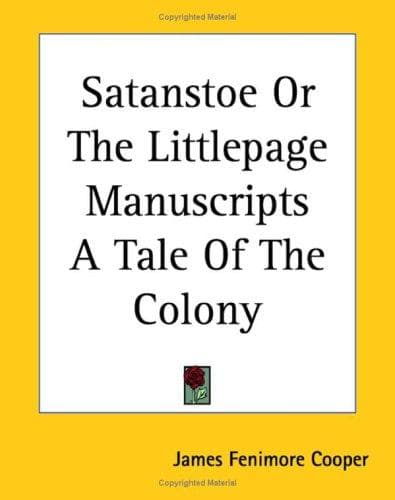
Satanstoe; Or, the Littlepage Manuscripts. A Tale of the ColonyCooper, James Fenimore
General
Satanstoe; Or, the Littlepage Manuscripts. A Tale of the Colony
Cooper, James Fenimore
Antirent War, N.Y., 1839-1846 -- Fiction
Herman Mordaunt expected no emolument to himself, from Ravensnest, but
looked forward solely to a provision for posterity. In consequence of these
views, he refused to sell, but gave leases on such conditions as would
induce tenants to come into his terms, in a country in which land was far
plentier than men. For some reason, that never was very clear to me, he was
particularly anxious to secure Jason Newcome, and no tolerable terms seemed
extravagant to effect his purpose. It is not surprising, therefore,
that our miller in perspective got much the best of the bargain, as its
conditions will show.
The lease was for three lives, and twenty-one years afterwards. This would
have been thought equal to a lease for forty-two years, in that day, in
Europe; but experience is showing that it is, in truth, for a much longer
period, in America. [35] The first ten years, no rent at all was to be
paid. For the next ten, the land, five hundred acres, was to pay sixpence
currency an acre, the tenant having the right to cut timber at pleasure.
This was a great concession, as the mill-lot contained much pine. For the
remainder of the lease, be it longer or shorter, a shilling an acre, or
about sixpence sterling, was to be paid for the land, and forty pounds
currency, or one hundred dollars a year, for the mill-seat. The mills to be
taken by the landlord, at an appraisal 'made by men', at the expiration of
the lease; the tenant to pay the taxes. The tenant had the privilege of
using all the materials for his dams, buildings, &c., he could find on the
land.
The policy of the owners of Mooseridge was different. We intended to sell
at low prices, at first, reserving for leases hereafter, such farms as
could not be immediately disposed of, or for which the purchaser failed to
pay. In this manner it was thought we should sooner get returns for our
outlays, and sooner 'build up a settlement,' as the phrase goes. In
America, the reader should know, everything is 'built.' The priest 'builds
up' a flock; the speculator, a fortune; the lawyer, a reputation; and the
landlord, a settlement; sometimes, with sufficient accuracy in language, he
even builds a town.
Jason was a very happy man, the moment he got his lease, signed and sealed,
in his own possession. It made him a sort of a land-holder on the spot, and
one who had nothing to pay for ten years to come. God forgive me, if I
do the man injustice; but, from the first, I had a suspicion that Jason
trusted to fortune to prevent any pay-day from ever coming at all. As for
Herman Mordaunt, he seemed satisfied, for he fancied that he had got a
man of some education on his property, who might answer a good purpose in
civilizing, and in otherwise advancing the interests of his estate.
Public-domain text, read in full here on John Shaqi.
Reviews
Reviews
No reviews yet
Be the first to share your thoughts on this work.
Elsewhere in the archive
Join the Discussion
Join the discussion
Sign in to leave a comment or review.
Sign InorCreate an account