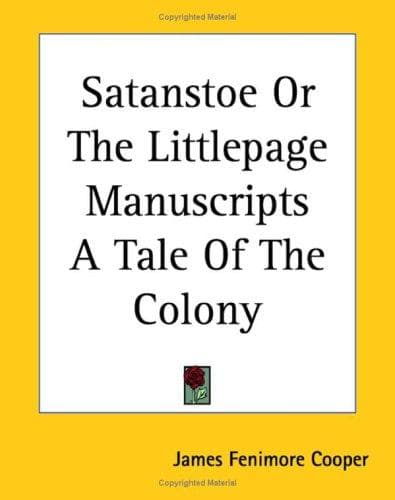
Satanstoe; Or, the Littlepage Manuscripts. A Tale of the ColonyCooper, James Fenimore
General
Satanstoe; Or, the Littlepage Manuscripts. A Tale of the Colony
Cooper, James Fenimore
Antirent War, N.Y., 1839-1846 -- Fiction
A glorious sight awaited me! The sun had just tipped the mountain-tops with
gold, while the lake and the valleys, the hill-sides even, and the entire
world beneath, still reposed in shadow. It appeared to me like the
awakening of created things from the sleep of nature. For a moment or more,
I could only gaze on the wonderful picture presented by the strong contrast
between the golden hill-tops and their shadowed sides--the promises of day
and the vestiges of night. But the Onondago was too much engrossed with his
own feelings, to suffer me long to disregard what he conceived to be the
principal point of interest. Directed by his finger, and eye, for he spoke
not, I turned my look towards the distant shore of William Henry, and at
once perceived the cause of his unusual excitement. As soon as the Indian
was certain that I saw the objects that attracted himself so strongly, he
exclaimed with a strong, guttural, emphatic cadence--
“Good!”
Abercrombie's army was actually in motion! Sixteen thousand men had
embarked in boats, and were moving towards the northern end of the lake,
with imposing force, and a most beautiful accuracy. The unruffled surface
of the lake was dotted with the flotilla, boats in hundreds stretching
across it in long, dark lines, moving on towards their point of destination
with the method and concert of an army with its wings displayed. The last
brigade of boats had just left the shore when I first saw this striking
spectacle, and the whole picture lay spread before me at a single glance.
America had never before witnessed such a sight; and it may be long before
she will again witness such another. For several minutes I stood entranced;
nor did I speak until the rays of the sun had penetrated the dusky light
that lay on the inferior world, as low as the bases of the western
mountains.
“What are we to do, Susquesus?” I then asked, feeling how much right the
Indian now might justly claim to govern our movements.
“Eat breakfast, first”--the Onondago quietly replied; “then go down
mountain.”
“Neither of which will place us in the midst of that gallant army, as it is
our wish to be.”
“See, bye'm by. Injin know--no hurry, now. Hurry come, when Frenchman
shoot.”
I did not like this speech, nor the manner in which it was uttered; but
there were too many things to think of, just then, to be long occupied by
vague conjectures touching the Onondago's evasive allusions. Guert and
Dirck were called, and made to share in the pleasure that such a sight
could not fail to communicate. Then it was I got the first notion of what I
should call the truly martial character of Ten Eyck. His fine, manly figure
appeared to me to enlarge, his countenance actually became illuminated, and
the expression of his eye, usually so full of good-nature and fun, seemed
to change its character entirely, to one of sternness and seventy.
Public-domain text, read in full here on John Shaqi.
Reviews
Reviews
No reviews yet
Be the first to share your thoughts on this work.
Elsewhere in the archive
Join the Discussion
Join the discussion
Sign in to leave a comment or review.
Sign InorCreate an account