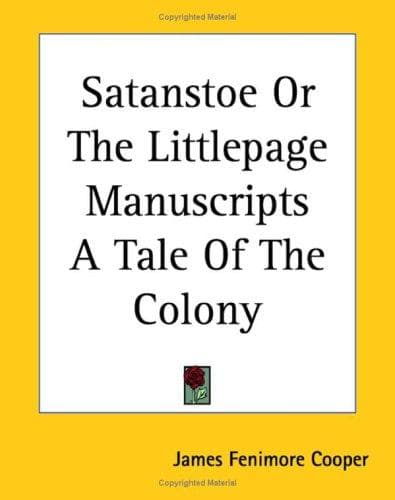
Satanstoe; Or, the Littlepage Manuscripts. A Tale of the ColonyCooper, James Fenimore
General
Satanstoe; Or, the Littlepage Manuscripts. A Tale of the Colony
Cooper, James Fenimore
Antirent War, N.Y., 1839-1846 -- Fiction
This was rather a puzzling question to answer to an Indian. We white people
can very well understand that a human government, which professes, on the
principles recognised by civilized nations, to have jurisdiction over
certain extensive territories that lie in the virgin forest, and which
are used only, and that occasionally, by certain savage tribes as
hunting-grounds, should deem it right to satisfy those tribes, by purchase,
before they parcelled out their lands for the purposes of civilized life;
but, it would not be so easy to make an unsophisticated mind understand
that there could be two owners to the same property. The transaction is
simple enough to us, and it tells in favour of our habits, for we have the
power to grant these lands without 'extinguishing the Indian title,' as it
is termed; but it presents difficulties to the understandings of those who
are not accustomed to see society surrounded by the multifarious interests
of civilization. In point of fact, the Indian purchases give no other
title, under our laws, than the right to sue out, in council, a claim
to acquire by, the grant of the crown; paying to the latter such a
consideration as in its wisdom it shall see fit to demand. Still, it was
necessary to make some answer to the Onondago's question, lest he might
carry away the mistaken notion that we did not justly own our possessions.
“Suppose you find a rifle to your fancy, Susquesus,” I said, after
reflecting a moment on the subject, “and you find two Indians who both
claim to own it; now, if you pay each warrior his price, is your right to
the title any the worse for having done so? Is it not rather better?”
The Indian was struck with this reply, which suited the character of his
mind. Thrusting out his hand, he received mine, and shook it cordially,
as much as to say he was satisfied. Having disposed of this episode thus
satisfactorily, we turned to the more interesting subject of our immediate
movements.
“It would seem that the Onondago expects the French Indians will now strike
at the settlements,” I remarked to my companions, “and, that our friends
at Ravensnest may need our aid; but, at the same time, he thinks we
should first return to Mooseridge, and join the surveyors. Which mode of
proceeding strikes you as the best, my friends?”
“Let us first hear the Injin's reasons for going after the surveyors,”
answered Guert. “If he has a sufficient reason for his plan, I am ready to
follow it.”
“Surveyor got scalp, as well as squaw,” said Susquesus, in his brief,
meaning manner.
“That must settle the point!” exclaimed Guert. “I understand it all, now.
The Onondago thinks the Mooseridge party may be cut off, as being alone and
unsupported, and that we ought to apprise them of this danger.”
Public-domain text, read in full here on John Shaqi.
Reviews
Reviews
No reviews yet
Be the first to share your thoughts on this work.
Elsewhere in the archive
Join the Discussion
Join the discussion
Sign in to leave a comment or review.
Sign InorCreate an account