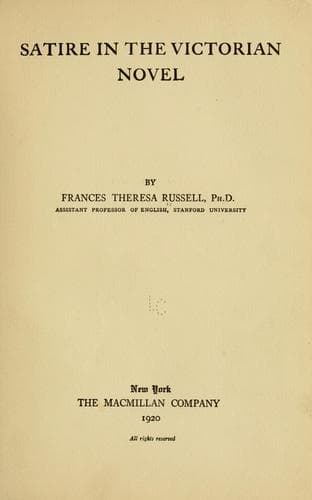
Satire in the Victorian novelRussell, Frances Theresa
History
Satire in the Victorian novel
Russell, Frances Theresa
English fiction -- 19th century -- History and criticism; Satire, English -- History and criticism; Thesis (Ph. D.)
It might seem that a romanticism so prevalent and avowed would not
be the best medium for satire, which is supposed to be realistic in
the sense that it deals with the actual. But since satire is directed
against persons rather than circumstances, it is in no danger so long
as the romancing is confined to the situations, and the characters
are kept to the plane of reality,--as is the case, with a few easily
recognizable exceptions, in the Victorian novel. That the difficulty
of truthfulness is one excuse for indulgence in the easier romantic
method, is admitted by Eliot:[413]
“The pencil is conscious of a delightful facility in drawing
a griffin--the longer the claws and the larger the wings, the
better; but that marvellous facility which we mistook for genius
is apt to forsake us when we want to draw a real, unexaggerated
lion.”
But in Victorian fiction neither griffins nor lions are in much
evidence. The total personnel is fairly well symbolized (with the
addition of a few more of the nobler brutes than are admitted by
Thackeray) in the Overture to _The Newcomes_, wherein the “farrago
of old fables” pictures a crow, a frog, an ox, a wolf, a fox, an
owl, and a few lambs, but only the skin of a lion,--and that serving
as cloak for a donkey. The romantico-realistic solution, therefore,
forms probably the most satisfactory base for the dissolving of the
critical-humorous acid and the precipitation of satire. It secures a
maximum of pungency with a minimum of flatness, and is perfectly safe
to take.
As satire ramifies on the critical side into pessimism, tragedy,
idealism, and the cognate matters of romanticism and realism, so it
extends on the humorous into the comic, the witty, and the philosophic
amusement known as a sense of humor.
Public-domain text, read in full here on John Shaqi.
Reviews
Reviews
No reviews yet
Be the first to share your thoughts on this work.
Elsewhere in the archive
Join the Discussion
Join the discussion
Sign in to leave a comment or review.
Sign InorCreate an account