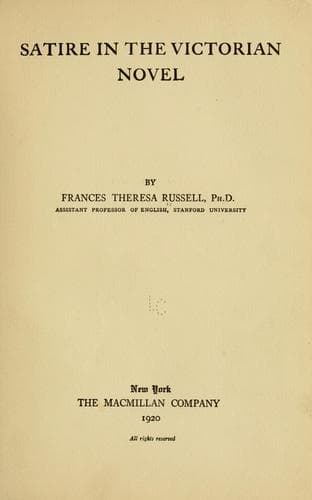
Satire in the Victorian novelRussell, Frances Theresa
History
Satire in the Victorian novel
Russell, Frances Theresa
English fiction -- 19th century -- History and criticism; Satire, English -- History and criticism; Thesis (Ph. D.)
In 1906 she became assistant in Philosophy at the Leland Stanford
Junior University, and in 1907, assistant in English. She was appointed
Instructor in the English Department in 1908, and Assistant Professor
in 1916. For the next two years she was registered as a graduate
student in the English Department of Columbia University, and in 1919
resumed her work at Stanford University, California.
FOOTNOTES:
[1] Churchill, in _The Author_.
[2] _Satires_, I, 10, 15.
[3] Drummond’s translation. A similar couplet is rendered by Evans,
“He, with a sly, insinuating grace,
Laugh’d at his friend, and look’d him in the face.”
[4] Preface to _Every Man in his Humour_.
[5] _Essay on Satire_, by the Duke of Buckingham: Dryden’s Works, XV,
201.
[6] Young: Preface to the _Seven Satires_.
[7] Fielding: _Historical Register_: Dedication to the Public, III, 341.
[8] Fielding: _Tom Jones_: Dedication to George Lyttleton, VI, 5.
He also says, in _The Covent Garden Journal_: “Few men, I believe, do
more admire the works of those great masters who have sent their satire
(if I may use the expression) laughing into the world. Such are the
great triumvirate, Lucian, Cervantes, and Swift.”
[9] Browning: _Aristophanes’ Apology_.
[10] Garnett, in the Enc. Brit. 9th edition.
[11]
“Wolves use their teeth against you, bulls their horn;
Why, but that each is to the manner born?”
_Satires_, I, 1. Conington, 46.
Some modern echoes are heard. Says Byron,--
“Satiric rhyme first sprang from selfish spleen;
You doubt--see Dryden, Pope, St. Patrick’s Dean.”
_Hints from Horace._
Taine applies his general theory to this instance:
“No wonder if in England a novelist writes satires. A gloomy and
reflective man is impelled to it by his character; he is still further
impelled by the surrounding manners.” _Hist. of Eng. Lit._ IV, 166.
In Shaw’s _An Unsocial Socialist_, one character says of another:
“Besides, Gertrude despises everyone, even us. Or rather, she doesn’t
despise anyone in particular, but is contemptuous by nature, just as
you are stout.”
[12] _Scourge of Villainy._
[13] _Apology for Smectymnuus._
[14] “The end of Satire is reformation.” Preface to _The Trueborn
Englishman_.
[15] “The true end of Satire is the amendment of vices by correction.”
Preface to _Absalom and Achitophel_.
[16] “Now the author, living in these times, did conceive it an
endeavour worthy an honest satirist, to dissuade the dull, and punish
the wicked, in the only way that was left.” Preface of Martinus
Scriblerus to _The Dunciad_.
[17] _An Essay on Satire._ Occasioned by the death of Pope. Inscribed
to Dr. Warburton. In Dodsley’s Collection of Poems, Vol. III.
[18] Fielding: _Covent Garden Journal_.
[19] Preface to the Translation of Juvenal.
[20] _Essay on Comedy_, 76.
[21] _The Renaissance in Italy_, V, 270.
[22] _Makers of English Fiction_, 86.
Public-domain text, read in full here on John Shaqi.
Reviews
Reviews
No reviews yet
Be the first to share your thoughts on this work.
Elsewhere in the archive
Join the Discussion
Join the discussion
Sign in to leave a comment or review.
Sign InorCreate an account