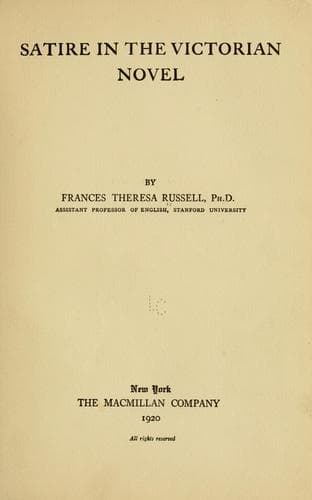
Satire in the Victorian novelRussell, Frances Theresa
History
Satire in the Victorian novel
Russell, Frances Theresa
English fiction -- 19th century -- History and criticism; Satire, English -- History and criticism; Thesis (Ph. D.)
[226] _Adam Bede_, I, 245. It could not be said of him as it was of
Vincy in the above connection,--“The difficult task of knowing another
soul is not for young gentlemen whose consciousness is chiefly made up
of their own wishes.”
[227] _Letters_, II, 501. In another he speaks of the fine irony
of French criticism, which “instructs without wounding any but the
vanitous person”: and adds that “England has little criticism beyond
the expression of likes and dislikes, the stout vindication of an old
conservatism of taste.” _Ibid._, 569.
[228] _The Egoist_, 43. (The “leg” of course referring to Mrs.
Jenkinson’s famous epigram).
[229] _The Egoist_, 113.
[230] _Sandra Belloni_, 157.
[231] _Ibid._, 153.
[232] _One of Our Conquerors_, 415.
[233] _Ibid._, 195.
[234] _Vittoria_, 373.
[235] _Beauchamp’s Career_, 369.
[236] _Sandra Belloni_, 68. This is followed by a fling at the
“alliance with Destiny”, which reminds us of our recent American slogan
of “Manifest Destiny.”
[237] _Letters_, II, 555. To Leslie Stephen, 1904.
[238] _An Amazing Marriage_, 480.
[239] _Ibid._, 147. Cf. also citations in the first part of this
chapter.
[240] _Middlemarch_, I, 142. She also comments as follows on the
undeniably just statement of Jermyn to Mrs. Transome that Harold should
be told the secret of his birth:
“Perhaps some of the most terrible irony of the human lot is this of
a deep truth coming to be uttered by lips that have no right to it.”
_Felix Holt_, II, 242.
[241] _Diana of the Crossways_, 423.
[242] _Evan Harrington_, 117.
[243] _Evan Harrington_, 137.
[244] _Rhoda Fleming_, 301. Later, however, an equivalent amount,
placed in his hands in trust for another purpose, conveniently paid
this debt. “It was enough to make one in love with civilization.”
_Ibid._, 326.
[245] _The Tragic Comedians_, 195.
[246] _Richard Feverel_, 8.
[247] _Ibid._, 322.
[248] Van Laun: _History of French Literature_, II, 27.
[249] Cf. also the riot of personalities in Blackwood’s, Frazer’s, and
other periodicals of their time.
[250] Butler’s etchings in _The Way of All Flesh_, are also from
personal sources.
[251] Freeman observes, “Peacock abused contemporary poets generally,
the Lake School particularly, and Southey in especial, for eighteen
years.” _Thomas Love Peacock, A Critical Study_, 141.
[252] _Melincourt_, 106.
[253] _Melincourt_, 108.
[254] _Nightmare Abbey_, 23. That this was a typical experience is well
known. Cf. Browning’s _Lost Leader_.
[255] _Ibid._, 49.
[256] _Melincourt_, 80. In his Review of Southey’s _Colloquies of
Society_, Macaulay points out the Laureate’s two unique faculties,--“of
believing without a reason, and of hating without a provocation.”
[257] Quoted in his biography, by the Earl of Lytton, I, 347.
The Ettrick Shepherd tries to rally Tickler out of his glumness by
the argument,--“Everybody kens ye’re a man of genius, without your
pretending to be melancholy.”
[258] _Beauchamp’s Career_, 39.
Public-domain text, read in full here on John Shaqi.
Reviews
Reviews
No reviews yet
Be the first to share your thoughts on this work.
Elsewhere in the archive
Join the Discussion
Join the discussion
Sign in to leave a comment or review.
Sign InorCreate an account