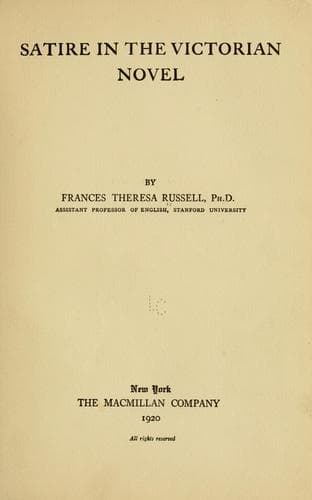
Satire in the Victorian novelRussell, Frances Theresa
History
Satire in the Victorian novel
Russell, Frances Theresa
English fiction -- 19th century -- History and criticism; Satire, English -- History and criticism; Thesis (Ph. D.)
[330] _Alton Locke_, 229–30. Cf. 205ff. for an equally forceful
presentation of the other side through the eloquent rebuke to illogical
complaints, given by Eleanor Staunton. It is in _Yeast_ that Papacy
is satirized, a typical hit being the unconscious irony of Vieuxbois’
assertion,--“I do not think that we have any right in the nineteenth
century to contest an opinion which the fathers of the Church gave in
the fourth.” 114. Alton Locke also says,--“A man-servant, a soldier and
a Jesuit, are to me the three great wonders of humanity--three forms of
moral suicide, for which I never had the slightest gleam of sympathy,
or even comprehension.” 187.
[331] _Beauchamp’s Career_, 622.
[332] _Erewhon_, 151.
[333] _Ibid._, 155.
[334] _Ibid._, 157. Cf. Kingsley’s statement that the working men
distrust the clergy. In _The Way of All Flesh_, Butler observes, “A
clergyman, again, can hardly ever allow himself to look facts fairly
in the face.” 103. Cf. also his _Note Books_, “In a way the preachers
believe what they preach, but it is as men who have taken a bad ten
pound note and refuse to look at the evidence that makes for its
badness, though, if the note were not theirs, they would see at a
glance that it was not a good one.” 190.
[335] _Erewhon Revisited_, 39–40. Panky, who wore his Sunchild suit
backward, as a matter of dogma, is supposed to represent the Anglican,
and Hanky the Jesuit. The broad church is represented by the far
superior Dr. Downie. Butler’s positive philosophy is expressed,
though still in the indirect manner, in the account of Ydgrun and the
Ydgrunites: _Erewhon_, Chap. XVII.
[336] In _The Duke’s Children_. Cf. _The Small House at Allington_,
498, for remarks on inadequate parents. Perhaps Meredith’s picture in
lighter tones, of Harry Richmond and his irresponsible but aspiring
father, might be mentioned.
[337] _Way of All Flesh_, 98.
[338] _Ibid._, 125.
[339] By J. L. Hughes, in _Dickens as an Educator_.
[340] _Dombey and Son_, II, 313.
[341] _David Copperfield_, I, 92.
[342] Cf. the beginning of same chapter for the school system generally.
[343] _Crochet Castle_, 115.
[344] _Ibid._, 32.
[345] _Pelham_, 13. Cf. his _Kenelm Chillingly_ for a discussion
between Uncle John, the idealistic vicar and Mivers, the utilitarian
man of the world, as to educational values. The latter believes
the parson’s rêgime would produce “either a pigeon or a ring-dove,
a credulous booby or a sentimental milk-sop.” The former makes a
thoughtful distinction between the public school, which ripens talent
but stifles genius, and the private, which is too enervating, making of
the boys either prigs or sissies. It is Mivers who advocates adapting
the style of education to the disposition of the individual; and
insuring development by putting the youthful mind in contact with the
most original and innovating thinkers of the day.
Public-domain text, read in full here on John Shaqi.
Reviews
Reviews
No reviews yet
Be the first to share your thoughts on this work.
Elsewhere in the archive
Join the Discussion
Join the discussion
Sign in to leave a comment or review.
Sign InorCreate an account