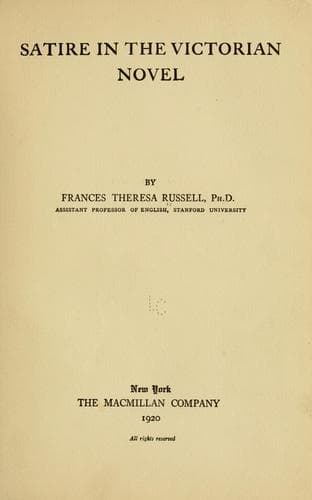
Satire in the Victorian novelRussell, Frances Theresa
History
Satire in the Victorian novel
Russell, Frances Theresa
English fiction -- 19th century -- History and criticism; Satire, English -- History and criticism; Thesis (Ph. D.)
[378] This conception of sentimentality has many illustrations,
expressed and implied. Chesterton describes the sentimentalist as “the
man who wants to eat his cake and have it,” who “has no sense of honour
about ideas,” and who keeps a quarreling “intellectual harem.” Crotch,
in his _Pageantry of Dickens_, remarks that the English “prefer a
plaster of platitudes to the x-rays of investigation.” Meredith in his
_Up to Midnight_, observes that liberty is one of the phrases we suck
like sweetmeats, and adds, “We read the newspapers daily, and yet we
surround ourselves with a description of scenic extravaganza conjured
up to displace uncomfortable facts. The image of it is the Florentine
Garden established in the midst of the Plague.”
See also Butler’s _Notebooks_, Anatole France’s essay on Dumas, and
Bailey’s biography of Meredith.
[379] _Melincourt_, 23.
[380] _North and South_, 9. Cf. Kingsley’s crude and literal handling
of the same theme. Anna Maria Heale was always talking of her nerves,
“though she had nerves only in the sense wherein a sirloin of beef has
them.” _Two Years Ago_, 85.
[381] _Wives and Daughters_, I, 394.
[382] _Ibid._, I, 324. Mrs. Gaskell’s art is shown in making Cynthia
a foil to her mother. Like Dr. Gibson and Molly, she sees through
that lady’s transparent veiling, but unlike them, she is more frank
than polite. Her distressingly literal interpretations of the subtle
speeches to which the household is treated, affords a contrast that is
lacking, for instance, in the duet of Mrs. Mackenzie and Rosey.
[383] _David Copperfield_, II, 102.
[384] _Dombey and Son_, I, 57.
[385] _Ibid._, 464.
[386] _Adam Bede_, I, 184.
[387] _Romola_, II, 469. Cf. _Two Years Ago_, for a sample of
Kingsley’s personally applied, Thackerayan sarcasm on a similar
subject,--we young men, “blinded by our self-conceit,” and so on.
[388] _Silas Marner_, 84. Cf. Catherine Arrowpoint’s interpretation of
parental piety: “People can easily take the sacred word duty as a name
for what they desire any one else to do.” _Daniel Deronda_, I, 370.
[389] _Middlemarch_, II, 61. She also refused to marry Fred Vincy if he
took orders, because she “could not love a man who is ridiculous.” He
would be so because of the entire absence of the clerical in his nature.
[390] _Sandra Belloni_, 220.
[391] _Ibid._, 4. He enlarges on this result of an effete civilization,
hinting that “our sentimentalists are a variety owing their existence
to a certain prolonged term of comfortable feeding. The pig, it will be
retorted, passes likewise through this training. He does. But in him it
is not combined with an indigestion of high German romances.”
[392] _Evan Harrington_, 349.
[393] _Sandra Belloni_, 152.
Public-domain text, read in full here on John Shaqi.
Reviews
Reviews
No reviews yet
Be the first to share your thoughts on this work.
Elsewhere in the archive
Join the Discussion
Join the discussion
Sign in to leave a comment or review.
Sign InorCreate an account