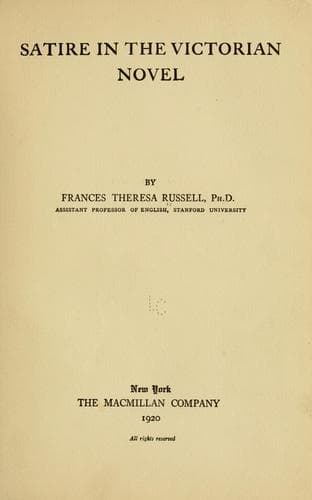
Satire in the Victorian novelRussell, Frances Theresa
History
Satire in the Victorian novel
Russell, Frances Theresa
English fiction -- 19th century -- History and criticism; Satire, English -- History and criticism; Thesis (Ph. D.)
In her Preface to the belated edition of _The Professor_, Charlotte
Brontë declared her own preference for a depiction of a normal and
unadorned existence to be thwarted by the lack of editorial enthusiasm.
After stating the condition of things she adds--
“* * * the publishers in general scarcely approved of this
system, but would have liked something more imaginative and
poetical--something more consonant with a highly wrought fancy,
with a taste for pathos, with sentiments more tender, elevated,
unworldly. Indeed, until an author has tried to dispose of
a manuscript of this kind he can never know what stores of
romance and sensibility lie hidden in breasts he would not have
suspected of casketing such treasures.”
An accurate description of Victorianism is contained in this ironic
indictment, and perhaps also an explanation of the romantic trend of
its realism on the ground of the law of supply and demand as well as
that of natural propensity.
Lytton prided himself prodigiously on his true rendering of life,
though of his two dozen novels, _The Caxtons_ alone approaches the
realistic type, and pictures in one of his heroes[119] a phase at least
of his artistic ideal:
“The humblest alley in a crowded town had something poetical
for him; he was ever ready to mix in a crowd, if it were only
gathered round a barrel-organ or a dog fight, and listen to all
that was said, and notice all that was done. And this I take to
be the true poetical temperament essential to every artist who
aspires to be something more than a scene-painter.”
That the satirical element in this romantico-realistic form of fiction
should be characterized by humor, exposure, and comparative rarity,
instead of wit, exaggeration, and ubiquity, is inevitable, since the
former qualities accord not only with realism but with one another.
Humor is the comic sense which is amused by things as they are, whereas
wit either creates the absurdity or ferrets it out of obscurity. Hence
the former is allied to the actual more than to the fanciful, and
uses the method of simple disclosure rather than caricature. While
therefore the imaginative energy of wit is dynamic, that of humor
is more quiescent, being sufficiently exercised by its function of
interpretation, of showing wherein lurks the spirit of the laughable,
however grave and solemn the appearance to the unseeing eye.
Where the quality of the satire is of this realistic order, the
quantity must necessarily be restricted and more or less incidental
rather than dominant; subdued, not rampant. For the true satirical
humorist, seeing life steadily and whole, observes that while certain
parts of it are unquestionably absurd, whether flauntingly or subtly
so, these ludicrous shreds and patches, absolutely integral and
ineradicable as they are, are nevertheless only a portion and not so
large a one, of the stupendous whole.
Public-domain text, read in full here on John Shaqi.
Reviews
Reviews
No reviews yet
Be the first to share your thoughts on this work.
Join the Discussion
Join the discussion
Sign in to leave a comment or review.
Sign InorCreate an account