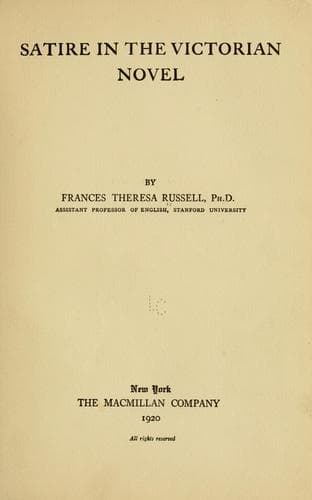
Satire in the Victorian novelRussell, Frances Theresa
History
Satire in the Victorian novel
Russell, Frances Theresa
English fiction -- 19th century -- History and criticism; Satire, English -- History and criticism; Thesis (Ph. D.)
Neither that astigmatic visualizer, the cynic, who regards life
itself as a huge joke on its victims, nor that myopic spectator, the
misanthrope, who conceives humanity as an unmitigated jest on creation,
was a Victorian favorite. Both are blind to certain phenomena,--beauty,
power, exquisite delicacy, tremendous strength,--which also exist,
which even the pessimist grants to be compensatory, and which, when
genuine, are utterly beyond the reach of any ridicule that pretends
to sanity or justice. Such then,--humorously truthful and suitably
proportioned,--is the general character of the satiric stratum which
runs, widening and narrowing, through the great vein of Victorian
fiction.
In the legitimate novel there are two main devices of revealing the
ludicrous; the direct, whereby the author in his own reflections and
comments points it out; and the dramatic, whereby he shows it by means
of incident and character. The latter method is again subdivisible into
two modes, by the use of the two contrasting types of actors, humorous
and humorists. The first are allowed to betray themselves, their very
unconsciousness adding to the piquancy of the situation. For this the
favorite technical tool is the dramatic monologue. The second are the
witty protagonists. They stand _in loco scriptoris_ and express
that detection of absurdity for which the humorless humorous furnish
the occasion.[120]
When we consult our original list, we find the two extremes have
been cut off, as Peacock and Butler belong entirely to the other
department. The remaining eleven have produced about one hundred
twenty novels in the stricter sense, not including short stories,
tales, sketches, or burlesques. It must be noted that this restriction
rules out some items important as literature, and in certain cases
as satire,--_Cranford_, _Pickwick_, _Peg Woffington_, _Scenes from
Clerical Life_.
Of the grand total, approximately one-quarter is eliminated as being
essentially and thoroughly serious. Here again are found some notable
names,--_Last Days of Pompeii_, _Mary Barton_, _Henry Esmond_, _Tale
of Two Cities_, _The Cloister and the Hearth_, _Jane Eyre_, _Hypatia_.
Three-fourths is a large majority, from which one might deduce that the
novel of this period was prevailingly satirical. But the other extreme,
those so strongly saturated as to deserve the name of satires, are
far fewer than the unsatirical. _Vanity Fair_, _Martin Chuzzlewit_,
_The Egoist_, possibly _Barchester Towers_, and _Beauchamp’s Career_,
practically exhaust the list. This leaves about four score of novels in
which the spirit of satire exists, manifesting itself showily, coyly,
in wide range and diversity.
Public-domain text, read in full here on John Shaqi.
Reviews
Reviews
No reviews yet
Be the first to share your thoughts on this work.
Join the Discussion
Join the discussion
Sign in to leave a comment or review.
Sign InorCreate an account