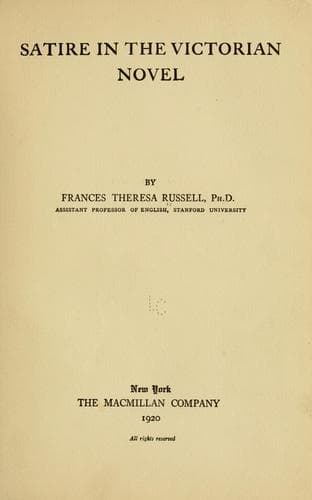
Satire in the Victorian novelRussell, Frances Theresa
History
Satire in the Victorian novel
Russell, Frances Theresa
English fiction -- 19th century -- History and criticism; Satire, English -- History and criticism; Thesis (Ph. D.)
Not only are our modern instances comparatively light in quality, but
restricted in range. The fable, for example, is not represented at
all, nor the allegory, though both forms have had a sort of revival
in even more recent times. These deficiencies, if such they are, are
easily accounted for by the fact that in the nineteenth century realism
(in the liberal sense) was having its day, that it had taken especial
possession of the Victorian novel, particularly in its satiric aspect,
so that such scattered fantasies as we have may be regarded as the
crumbs from an opulent table.
The marks of the satiric extravaganza are wit, invention, and
exaggeration. In a general way the opposites of these may be called
respectively humor, interpretation, and exposure; and it may be
premised that these last will be found the characteristics of satiric
realism.
Another contrast that may be anticipated is that when romance is used
as a satiric vehicle it is built expressly for that purpose and carries
its passenger in solitary state; while realism is a public carry-all,
in which this fare is allowed a place along with the others.
Whether further generalization as to relative effectiveness is possible
is a question that must be deferred until after the discussion of the
complementary type.
CHAPTER II
THE REALISTIC
Realism in Victorian fiction, as we need only to be reminded, means not
strictly that which is, but liberally that which might be. Its field is
nominally the Actual but it encroaches unhesitatingly on the domain of
the Probable, laps over into the Improbable, and barely halts at the
Impossible. These expansive habits make it not incompatible with the
Romantic, which indeed, in its soberer aspects, is a constant factor in
the English novel up to and including this period.
Romanticism is reduced to a minimum by Maria Edgeworth, Jane Austen,
Mrs. Gaskell, and Anthony Trollope,[118] but the majority of our
novelists have not been thus content to present life in its everyday
garb, neat and prosperous enough, it may be, but neutral, inane,
diffuse, inconclusive. They have insisted in the name of decorum and
dignity on the dress costume and company manners which in civilized
society are a prerequisite to public appearance and conspicuous
position. Life is still life and not an impostor, even when robed in
its best with some artifice of color and ornament and some evidence of
decisive purposefulness in mien and bearing.
But however romantic in effect, the nineteenth-century novel was
realistic in intent, and we may in a measure take the will for the
deed. Of this devotion to reality we have several testimonies, from
such important witnesses as Trollope, Dickens, Thackeray; but two are
of especial interest as they come from two of the most undeniable
romanticists, Lytton and Brontë.
Public-domain text, read in full here on John Shaqi.
Reviews
Reviews
No reviews yet
Be the first to share your thoughts on this work.
Join the Discussion
Join the discussion
Sign in to leave a comment or review.
Sign InorCreate an account