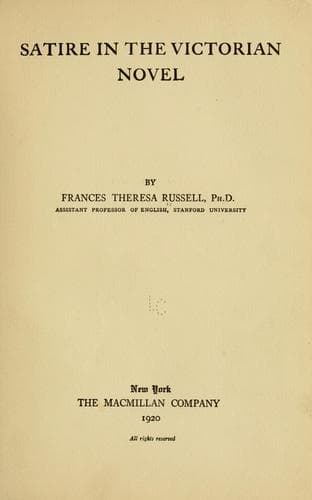
Satire in the Victorian novelRussell, Frances Theresa
History
Satire in the Victorian novel
Russell, Frances Theresa
English fiction -- 19th century -- History and criticism; Satire, English -- History and criticism; Thesis (Ph. D.)
When an author uses the direct method for the conveyance of
satirical ideas, he becomes for the nonce a didactic, though
humor-flavored, philosopher. Over against the artistic liabilities
incurred,--interruption of the narrative, intrusion of more or less
irrelevant matter, may be placed the intellectual assets,--presentation
of opinions and conclusions, and frank expression of personality.
Whether approved of or not, this discursive habit must be accepted as
an old inheritance. From the beginning, the English novel has been a
hybrid, the drama grafted on the treatise. Even the medieval mind,
with its insatiable relish for the pageantry of life, had an uneasy
feeling that the Merry Tale should not be entirely its own reward, and
accordingly found for it a moral justification, whereby pleasure and
profit were joined in a most complacent alliance. And ever since, the
prevailing purpose has been not only to portray life but to exhibit
this or that deduction about life.
In the eighteenth century this tendency took definite shape and
substance, for then it became notably true that the division between
narrative and essay was not coincident with a division between
narrators and essayists. Swift, Addison, Defoe, Fielding, Sterne,
were both. And it was their mantle and not that of romance writers,
Gothic or Historical, that best fitted Victorian shoulders. Of the
many testimonies to this, direct and indirect, the following from a
characteristic Victorian pen may be cited as evidence:[121]
“The reader of a novel--who had doubtless taken the volume up
simply for amusement, and who would probably lay it down did he
suspect that instruction, like a snake-in-the-grass, like physic
beneath the sugar, was to be imposed upon him--requires from his
author chiefly this, that he shall be amused by a narrative in
which elevated sentiment prevails, and gratified by being made
to feel that the elevated sentiments described are exactly his
own.”
He then goes on to show that this morality is best served by realism,
in spite of the superior attractions of heroes and villains:[122]
“But for one Harry Esmond, there are fifty Ralph Newtons--five
hundred and fifty of them; and the very youth whose bosom glows
with admiration as he reads of Harry--who exults in the idea
that as Harry did, so would he have done--lives as Ralph lived,
is less noble, less persistent, less of a man even than was
Ralph Newton.
Public-domain text, read in full here on John Shaqi.
Reviews
Reviews
No reviews yet
Be the first to share your thoughts on this work.
Join the Discussion
Join the discussion
Sign in to leave a comment or review.
Sign InorCreate an account