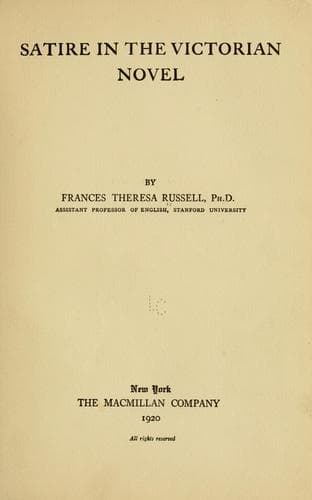
Satire in the Victorian novelRussell, Frances Theresa
History
Satire in the Victorian novel
Russell, Frances Theresa
English fiction -- 19th century -- History and criticism; Satire, English -- History and criticism; Thesis (Ph. D.)
“It is the test of a novel-writer’s art that he conceals his
snake-in-the-grass; but the reader may be sure that it is
always there. * * * In writing novels, we novelists preach to
you from our pulpits, and are keenly anxious that our sermons
shall not be inefficacious. * * * Nevertheless, the faults of a
Ralph Newton, and not the vices of a Varney or a Barry Lyndon,
are the evils against which men should in these days be taught
to guard themselves--which women also should be made to hate.
Such is the writer’s apology for his very indifferent hero,
Ralph the Heir.”
In another volume[123] the same writer confesses,--
“Castles with unknown passages are not compatible with my homely
muse. I would as lief have to do with a giant in my book--a real
giant, such as Goliath--as with a murdering monk with a scowling
eye. The age for such delights is, I think, gone. We may say
historically of Mrs. Radcliffe’s time that there were mysterious
sorrows in those days. They are now as much out of date as the
giants.”
Victorianism of course had her own sorrows, patent and unmysterious as
they were. At no time could she have been mistaken for Elizabethanism.
But she grew gradually in strength and sobriety, and cast a heavier
shadow in the afternoon of the century. In its mid-morning Disraeli
could compliment his own _Young Duke_ with the subtitle, “a moral tale
though gay.” And the chief ambition of the young writers up to the
early forties seems to have been to produce tales that were gay though
moral.
Of this tendency Lytton is the most conspicuous example. Innately
serious and thoroughly sentimental, he nevertheless dared not be as
solemn as he could. He must live up to the requirement for ironic wit
and the light touch of _savior faire_, even though, lacking native
exuberance and somewhat deficient in taste, he often fell into the
slough of facetiousness, or at least lapsed into childish jocularity.
To quote him at his best, however, we take a few excerpts from the
last of his trilogy of domestic novels. In the second of the series,
_My Novel_, he had adapted the prefatory device of _Tom Jones_, using
the remarks of the Caxton family as a sort of introductory (or more
properly, retrospective) chorus to each book. In _What Will He Do
with It_, the idea is carried out on a smaller scale, in expository
paragraphs preliminary to chapters. The following will be sufficient to
indicate the tone:
Book I
Chapter XII
Public-domain text, read in full here on John Shaqi.
Reviews
Reviews
No reviews yet
Be the first to share your thoughts on this work.
Join the Discussion
Join the discussion
Sign in to leave a comment or review.
Sign InorCreate an account