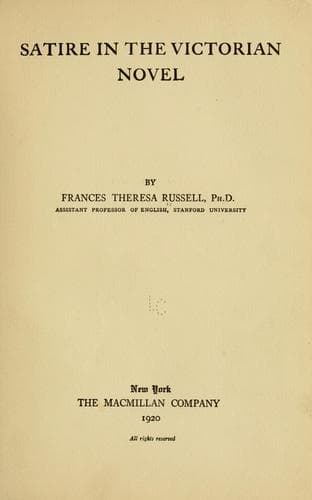
Satire in the Victorian novelRussell, Frances Theresa
History
Satire in the Victorian novel
Russell, Frances Theresa
English fiction -- 19th century -- History and criticism; Satire, English -- History and criticism; Thesis (Ph. D.)
“If there is any exhibition in all Vanity Fair which Satire
and Sentiment can visit arm in arm together; where you light
on the strangest contrasts laughable and tearful; where you
may be gentle and pathetic, or savage and cynical with perfect
propriety; it is at one of those public assemblies, a crowd of
which are advertised every day in the last page of the ‘Times’
newspaper, and over which the late Mr. George Robins used to
preside with so much dignity.”
And again:[125]
“This is a species of dignity in which the high-bred British
female reigns supreme. To watch the behavior of a fine lady
to other and humbler women, is a very good sport for a
philosophical frequenter of Vanity Fair.”
He delights in whimsical classic comparisons:[126]
“Is this case a rare one? and don’t we see every day in the
world many an honest Hercules at the apron-strings of Omphale,
and great whiskered Samsons prostrate in Delilah’s lap?”
Sometimes the classical is mingled in with the Scriptural:[127]
“A good housewife is of necessity a humbug; and Cornelia’s
husband was hoodwinked, as Potiphar was--only in a different
way.”
Sometimes we have a scientific simile, as the comment on Becky’s
ambition to be presented at Court.[128]
“If she did not wish to lead a virtuous life, at least she
desired to enjoy a character for virtue, and we know that no
lady in the genteel world can possess this desideratum, until
she has put on a train and feathers, and has been presented to
her Sovereign at court. From that august interview they come
out stamped as honest women. The Lord Chamberlain gives them
a certificate of virtue. And as dubious goods or letters are
passed through an oven at quarantine, sprinkled with aromatic
vinegar, and then pronounced clean--many a lady whose reputation
would be doubtful otherwise and liable to give infection, passes
through the wholesome ordeal of the Royal Presence, and issues
from it free from all taint.”
In his later novels Thackeray used in greater proportion the more
artistic indirect method, although he could more easily have plucked
out his eye and cast it from him than to have performed the same
operation on his habit of moralizing, which most frequently took the
form of a semi-whimsical but wholly homiletic exhortation to his dear
readers to make a personal application of the lessons involved in the
story.[129]
Of these later instances, one illustrates the use of literary allusion,
neatly combined with the commercial.[130]
Public-domain text, read in full here on John Shaqi.
Reviews
Reviews
No reviews yet
Be the first to share your thoughts on this work.
Join the Discussion
Join the discussion
Sign in to leave a comment or review.
Sign InorCreate an account