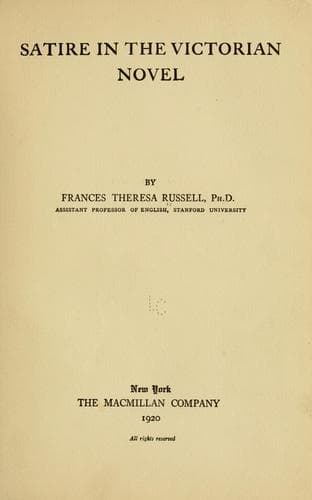
Satire in the Victorian novelRussell, Frances Theresa
History
Satire in the Victorian novel
Russell, Frances Theresa
English fiction -- 19th century -- History and criticism; Satire, English -- History and criticism; Thesis (Ph. D.)
“Though, no doubt, in these matters, when Lovelace is tired
of Clarissa (or the contrary), it is best for both parties to
break at once, * * * yet our self-love, or our pity, or our
sense of decency, does not like that sudden bankruptcy. Before
we announce to the world that our firm of Lovelace and Co.
can’t meet its engagements, we try to make compromises; we have
mournful meetings of partners; we delay the putting up of the
shutters, and the dreary announcement of the failure. It must
come: but we pawn our jewels to keep things going a little
longer.”
Dickens is included with this “didactic” trio, not so much because he
belongs with them as because he does not belong with the others. He
cannot be classed as a negative example, but his positive contributions
are relatively small. His artistic superiority to Thackeray in this
respect comes, however, not from a greater knowledge of artistry, and
even less from greater care for it, but through the happy accident of a
vivid, dramatic temperament. He refrains from much moralizing not, we
are sure, because he loves moralizing less but because he loves people
and actions more. His overwhelming interest in these, his affection and
respect for the doings and sayings of his characters, is too intense
to allow of their being interrupted by anything. He is thus something
of an artist unaware. He does not work out his own salvation by taking
thought or by deliberating over ways and means; but through a fortunate
preoccupation, an absorbing engagement with the concrete, he almost
unconsciously dispenses with the abstract, or expresses it in terms of
the specific.
It is true also that he segregates a good deal of his reflection in
his Prefaces; but it crops up too often in the course of the narrative
to be disregarded. One of the first showings occurs in connection with
Mr. Bumble’s relinquishment of the beadle’s costume together with that
office, and his pensive cogitations thereupon.[131]
“There are some promotions in life, which, independent of the
more substantial rewards they offer, acquire peculiar value and
dignity from the coats and waistcoats connected with them.
A field-marshal has his uniform; a bishop his silk apron; a
counsellor his silk gown; a beadle his cocked hat. Strip the
bishop of his apron, or the beadle of his hat and lace; what are
they? Men. Mere men. Dignity, and even holiness too, sometimes,
are more questions of coat and waistcoat than some people
imagine.”
In his next novel, Dickens has a word for those “who pamper their
compassion and need high stimulants to rouse it,” and indicates the
cause of hysterical zeal on the one hand or dull indifference on the
other, equally misplaced:[132]
Public-domain text, read in full here on John Shaqi.
Reviews
Reviews
No reviews yet
Be the first to share your thoughts on this work.
Join the Discussion
Join the discussion
Sign in to leave a comment or review.
Sign InorCreate an account