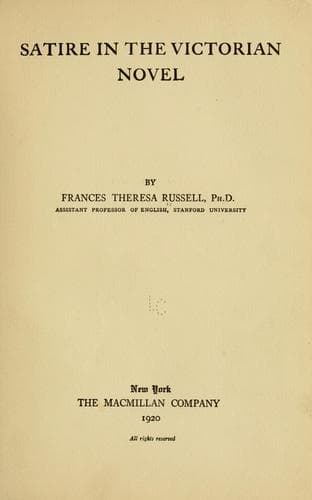
Satire in the Victorian novelRussell, Frances Theresa
History
Satire in the Victorian novel
Russell, Frances Theresa
English fiction -- 19th century -- History and criticism; Satire, English -- History and criticism; Thesis (Ph. D.)
Two others besides George Eliot have made a single but notable
contribution to this list, Thackeray and Charlotte Brontë. Rebecca
Sharp is too well known to need more than appreciative mention. Shirley
Keeldar is interesting as being what the author’s “sister Emily
might have been.” She is a spicily sweet, lovable character, clearly
presented both in action and in such touches of description as,[156]
“* * * ever ready to satirize her own or any other person’s
enthusiasm, she would have given a farm of her best land for a
chance of rendering good service.”
She converses with her friend Caroline about literature:[157]
“Milton was great; but was he good? His brain was right; how was
his heart? * * * Milton tried to see the first woman; but, Cary,
he saw her not. * * * It was his cook that he saw; or it was
Mrs. Gill, * * * preparing a cold collation for the rectors. * *
* I would beg to remind him that the first men of the earth were
Titans, and that Eve was their mother.”
In a spirited speech to Uncle Sympson, who craved to get rid of the
exasperating minx by disposing of her in respectable matrimony, she
baits and badgers him until his feeble intellect is nearly shattered,
ideas outraged, temper twisted beyond repair. No Victorian young niece
should say to an elderly conventional guardian:[158]
“Your god, sir, is the World. * * * Your great Bel, your
fish-tailed Dagon. * * * See him busied at the work he likes
best--making marriages. He binds the young to the old, the
strong to the imbecile. He stretches out the arm of Mezentius
and fetters the dead to the living.”
The novelist most admittedly generous to women is Meredith, and we have
him to thank for Margaret Lovell, Mrs. Mountstuart Jenkinson, Diana
Warwick, and Clara Middleton, with Mrs. Berry as a sort of compromise
between Mrs. Poyser and Mrs. Tulliver. Yet they do not any more than
live up to their boasted reputations, as dainty rogues in porcelain,
famous epigrammatists, the quoted astonishment of drawing-rooms.[159]
The real Victorian Shakespeare in the matter of women is Trollope. Not
entirely unworthy of the sisterhood of Beatrice, Viola, and Portia, are
Miss Dunstable, Lily Dale, Lucy Robarts, and Violet Effingham; Madeline
Stanhope might be added as a village Cleopatra.
Lily Dale is plaintively sympathetic on the subject of the sorrows of
men through the vexations of their amusements:[160]
Public-domain text, read in full here on John Shaqi.
Reviews
Reviews
No reviews yet
Be the first to share your thoughts on this work.
Elsewhere in the archive
Join the Discussion
Join the discussion
Sign in to leave a comment or review.
Sign InorCreate an account