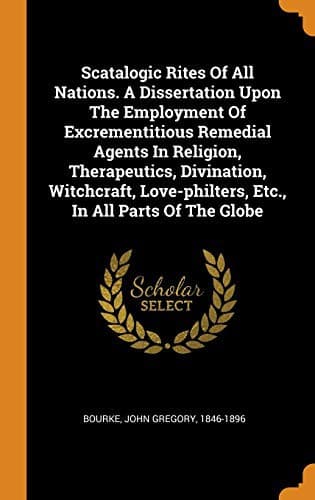
Scatalogic Rites of All Nations: A dissertation upon the employment of excrementitious remedial agents in religion, therapeutics, divination, witchcraft, love-philters, etc., in all parts of the globeBourke, John Gregory
Religion
Scatalogic Rites of All Nations: A dissertation upon the employment of excrementitious remedial agents in religion, therapeutics, divination, witchcraft, love-philters, etc., in all parts of the globe
Bourke, John Gregory
Scatology
“A prince may sacrifice his enemy, having first invoked the axe with holy
texts, by substituting a buffalo or goat, calling the victim by the name
of the enemy throughout the whole ceremony.”—(“The Sanguinary Chapter,”
translated from the “Calica Purana,” in vol. 5, “Transactions Asiatic
Society,” 4th edition, London, 1807, p. 386.)
“An interesting chapter of the Aitareya-brahmanam, on the sacrifice of
animals, shows us how, next to man, the horse was the supreme sacrifice
offered to the gods; how the cow afterwards took the place of the horse,
the sheep of the cow, the goat of the sheep; and at last vegetable
products were substituted for animals,—a substitution or cheating of
the gods in the sacrifice, which perhaps explains even more the fraud
of which, in popular stories, the simpleton is always the victim; the
simpleton hero being the god himself, and the cheater man, who changes,
under a sacred pretext, the noblest and most valued animals for common
and less valued ones, and finally for vegetables apparently of no value
whatever. In Hindu codes of law we have the same fraudulent substitution
of animals under a legal pretext. ‘The killer of a cow,’ says the code
attributed to Yagnavalkyas, ‘must stay a month in penitence, drinking
the panchakaryam’ (that is, the five good productions of the cow, which,
according to Manus, are milk, curds, butter, urine, and dung), sleeping
in a stable, and following the cows.’”—(“Zoöl. Mythol.,” De Gubernatis,
vol. i. pp. 44, 45.)
“The sacred books of the Hindus contain the most formal and detailed
instructions about human sacrifices, and on what occasions and with what
ceremonies they are to be offered; sometimes on an enormous scale,—as
many as one hundred and fifty human victims at one sacrifice.”—(Ragozin,
“Assyria,” New York, 1887, pp. 127-128.)
Continuing, Ragozin says: “When bloody sacrifices, even of animals, were
in great part abolished, and offerings of cakes of rice and wheat were
substituted, the humane change was authorized by a parable which told how
the sacrificial virtue had left the highest and most valuable victim,
man, and descended into the horse, from the horse into the steer, from
the steer into the goat, from the goat into the sheep, and from that at
last passed into the earth, where it was found abiding in the grains of
rice and wheat laid in it for seed.
“This was an ingenious way of intimating that henceforth harmless
offerings of rice and wheat cakes would be as acceptable to the deity as
the living victims, human and animal, formerly were.”—(Idem, p. 128.)
As the animal victim became more and more valuable, we have seen that its
excreta were offered in its place.
Public-domain text, read in full here on John Shaqi.
Reviews
Reviews
No reviews yet
Be the first to share your thoughts on this work.
Elsewhere in the archive
Join the Discussion
Join the discussion
Sign in to leave a comment or review.
Sign InorCreate an account