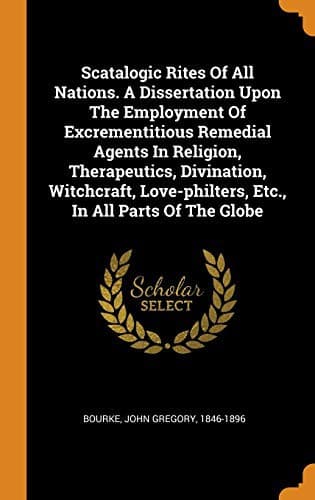
Scatalogic Rites of All Nations: A dissertation upon the employment of excrementitious remedial agents in religion, therapeutics, divination, witchcraft, love-philters, etc., in all parts of the globeBourke, John Gregory
Religion
Scatalogic Rites of All Nations: A dissertation upon the employment of excrementitious remedial agents in religion, therapeutics, divination, witchcraft, love-philters, etc., in all parts of the globe
Bourke, John Gregory
Scatology
The employment of manures as fuel for firing pottery among Moquis, Zuñis,
and other Pueblos, and for general heating in Thibet, has been pointed
out by the author in a former work. (“Snake Dance of the Moquis,” London,
1884.) It was used for the same purpose in Africa, according to Mungo
Park. (“Travels,” etc., p. 119.) The dung of the buffalo served the same
purpose in the domestic economy of the Plains Indians. Camel dung is the
fuel of the Bedouins; that of men and animals alike was saved and dried
by the Syrians, Arabians, Egyptians, and people of West of England for
fuel. Egyptians heated their lime-kilns with it.—(McClintock and Strong,
“Dung.” See, also, Kitto’s Biblical Encyclopædia, article “Dung.”)
Pocock says of camel dung: “In order to make fuel of it, they mix it, if
I mistake not, with chopped straw, and, I think, sometimes with earth,
and make it into cakes and dry it; and it is burnt by the common people
in Egypt; for the wood they burn at Cairo is very dear, as it is brought
from Asia Minor.”—(Pocock, in Pinkerton, vol. xv. p. 381.)
Bruce does not allude to any of the filthy customs which are detailed by
Schweinfurth, Sir Samuel Baker, and others; he does say that the Nuba
of the villages called Daher, at the head of the White Nile, Abyssinia,
“never eat their meat raw as in Abyssinia; but with the stalk of the
dura or millet and the dung of camels they make ovens under ground, in
which they roast their hogs whole, in a very cleanly and not disagreeable
manner.”—(“Nile,” Dublin, 1791, vol. v. p. 172.)
“Argol, the dried dung of camels, is the common fuel of
Mongolia.”—(“Among the Mongols,” Rev. James Gilmour, London, 1883, pp.
84, 146, 191, 296.)
The dung of camels is the fuel of the Kirghis.—(See “Oriental and Western
Siberia,” T. W. Atkinson, New York, 1865, pp. 218, 221.)
See also “From Paris to Pekin,” Meignan, London, 1885, pp. 186, 306, 310,
333; Burton’s edition of the “Arabian Nights,” vol. iii. p. 51; Father
Gerbillon’s Account of Tartary, in Du Halde, vol. iv. p. 151.
“Asses’ dung used for fuel and other purposes, such as making Joss
sticks.”—(Burton’s edition of the “Arabian Nights,” vol. ii. p. 149,
footnote.)
Cow-dung fuel and sheep-dung fuel alluded to by Huc, as used in
Thibet.—(See also Manning, Bogle, and Della Penna, in Markham’s “Thibet,”
London, 1879, p. 70.)
Friar William de Rubruquis, the Minorite, sent as ambassador to the Grand
Khan of Tartary, by Saint Louis, King of France, in 1253, speaks of
eating “Unleavened bread baked in Oxe-Dung or Horse-dung” (in Purchas,
vol. i. p. 34). Cow dung used for the same purpose in Thibet.—(See
Turner’s “Embassy to Thibet,” London, 1806, p. 202.)
“Cowe-dung fewell,” in Malta, mentioned by Master George Sandys, A.D.
1610 (in Purchas, vol. ii. p. 916).—(“Stercus bouinum,” in Egypt, idem,
vol. ii. p. 898.)
Yak manure used as fuel in Eastern Thibet, according to W. W. Rockhill in
“Border Land of China,” in “Century” Magazine, New York, 1890.
Public-domain text, read in full here on John Shaqi.
Reviews
Reviews
No reviews yet
Be the first to share your thoughts on this work.
Elsewhere in the archive
Join the Discussion
Join the discussion
Sign in to leave a comment or review.
Sign InorCreate an account