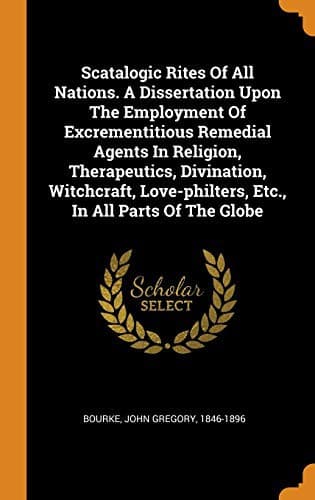
Scatalogic Rites of All Nations: A dissertation upon the employment of excrementitious remedial agents in religion, therapeutics, divination, witchcraft, love-philters, etc., in all parts of the globeBourke, John Gregory
Religion
Scatalogic Rites of All Nations: A dissertation upon the employment of excrementitious remedial agents in religion, therapeutics, divination, witchcraft, love-philters, etc., in all parts of the globe
Bourke, John Gregory
Scatology
The drinking of the water in which a new-born babe had been bathed is
intimated in the myths of the Samoans. When the first baby was born
“Salevao provided water for washing the child, and made it Saor, sacred
to Moa. The rocks and the earth said they wished to get some of that
water to drink. Salevao replied that if they got a bamboo he would send
them a streamlet through it, and hence the origin of springs.”—(“Samoa,”
Turner, London, 1884, p. 10.)
Although it is not so stated in the text, yet from analogy with other
cosmogonies we may entertain a suspicion as to how the god provided the
water,—no doubt from his own person.
STERCORACEOUS CHAIR OF THE POPES.
“Stercoraire, Chaire (Hist. des Papes); c’est ainsi qu’on nommoit à Rome,
au rapport de M. L’Enfant, une chaire qui étoit autrefois devant le
portique de la basilique, sur laquelle on faisait asseoir le Pape le jour
de sa consécration. Le chœur de musique lui chantoit alors ces paroles
du Psaume 113, selon l’Hébreu, et le 112, selon la Vulgate, v. 6, et
suiv. ‘Il tire de la poussière celui qui est dans l’indigence et il élève
le pauvre de son avilissement pour le placer avec les princes de son
peuple;’ c’étoit pour insinuer au Pape, dit cardinal Raspon, la vertu de
l’humilité, qui doit être la compagne de sa grandeur. Cet usage fut aboli
par Léon X, qui n’étoit pas né pour ces sortes de minuties.”—(“Encyc.
ou Dict. Raison. des Sciences,” etc., Neufchatel, 1765, tome quinzième,
article as above.)
Consult Ducange also, “Stercoraria Sedes,” wherein it is stated that the
use of this chair could be traced back to the tenth century.
“Stercoraria sedes, in qua creati pontifices ad frangendos elatos
spiritus considerent, unde dicta.”—(Baronius, “Annales,” Lucca, 1758.)
Read also the remarks upon the subject of Ducking Stools, from which this
seems to have been derived, under “Ordeals and Punishments.”
Father Le Jeune relates, among the ceremonies observed by the Indians
of Canada upon capturing a bear, that no women were allowed to remain
in the lodge with the carcass, and that special care was taken to
prevent dogs from licking the blood, gnawing the bones, or _eating the
excrement_.—(See “Relations,” 1634, vol. i., Quebec, 1858.)
XXIX.
ORDURE IN SMOKING.
Among all the observances of the every-day life of the American
aborigines, none is so distinctly complicated with the religious idea
as smoking; therefore, should the use of excrement, human or animal, be
detected in this connection, full play should be given to the suspicion
that a hidden meaning attaches to the ceremony. This would appear to
be the view entertained by the indefatigable missionary, De Smet, who
records such a custom among the Flatheads and Crows in 1846: “To render
the odor of the pacific incense agreeable to their gods it is necessary
that the tobacco and the herb (skwiltz), the usual ingredients, should be
mixed with a small quantity of buffalo dung.”[63]
Public-domain text, read in full here on John Shaqi.
Reviews
Reviews
No reviews yet
Be the first to share your thoughts on this work.
Elsewhere in the archive
Join the Discussion
Join the discussion
Sign in to leave a comment or review.
Sign InorCreate an account