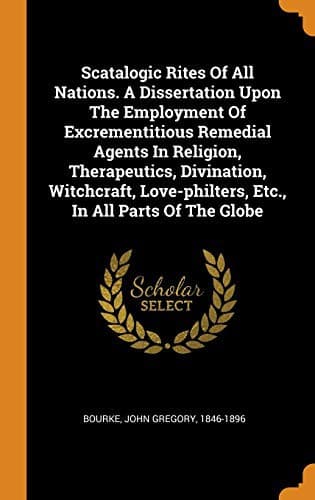
Scatalogic Rites of All Nations: A dissertation upon the employment of excrementitious remedial agents in religion, therapeutics, divination, witchcraft, love-philters, etc., in all parts of the globeBourke, John Gregory
Religion
Scatalogic Rites of All Nations: A dissertation upon the employment of excrementitious remedial agents in religion, therapeutics, divination, witchcraft, love-philters, etc., in all parts of the globe
Bourke, John Gregory
Scatology
Brand enumerates obsolete recipes, one of which (disease not mentioned)
directed the patient to take “five spoonfuls of knave child urine of an
innocent.”—(Brand, “Pop. Ant.,” London, 1849, vol. iii. p. 282.)
The Crees apply the dung of animals lately killed to sprains.—(See
“Mackenzie’s Voyages,” etc., to the Arctic Circle, London, 1800, introd.
p. 106.)
Henry M. Stanley says that, for the cure of certain ulcers due to
fly-blow, from which his men suffered, “Safeni, my coxswain on the
Victoria Nyanza, ... adopted a very singular treatment, which I must
confess was also wonderfully successful.... This medicine consisted of a
powder of copper and child’s urine, painted over the wound with a feather
twice a day.”—(“Through the Dark Continent,” New York, 1878, vol. ii. p.
369.)
“It appeared that the dung of the donkey, rubbed on the skin, was
supposed to be a cure for rheumatism, and that this rare specific
was brought from a distant country in the East, where such animals
exist.”—(“The Albert Nyanza,” Sir Samuel Baker, Philadelphia, 1869, p.
372.)
“The Mandingoes of Africa dress abscesses with cow’s dung.”—(See Mungo
Park’s “Travels in Africa,” in Pinkerton, vol. xvii. p. 877. See, also,
the edition of his works, “Travels in Africa,” New York, etc.)
The author has seen cow-manure plastered with soothing effect upon
bee-stings in New Jersey.
“Pro remedio, in pluribus morbis urina fœminæ externe applicata, in
eximia estimatione habetur.”—(“The Native Tribes of South Australia,”
Adelaide, 1879, introduction, xvi. See, also, Eyre, “Expedition into
Central Australia,” London, 1845, ii. 300.)
“Pilgrim’s Salve. A Sir-Reverence; human excrement.”—(Grose, “Dictionary
of Buckish Slang,” London, 1811.)
“The medicine-men of the Ove-herero, who live south of Angola (which is
on the west coast of Africa), urinate over the sick, in order to cure
them.”—(“Muhongo,” interpretation by Rev. Mr. Chatelain.)
The Inuit medicine-man asperses the sick with human urine, “le
goupillonne avec de vieilles urines, à l’instar des docteurs à poison
bochimans ... les Cambodgiens aspergent également le démon de la
petite-vérole avec de l’urine, mais cette urine est celle d’un cheval
blanc.”—(Réclus, “Les Primitifs,” p. 98.)
“There are few complaints that the natives do not attempt to cure, either
by charms or by specific applications. Of the latter, a very singular one
is the application personally of the urine from a female,—a very general
remedy, and considered a sovereign one for most disorders.”—(Eyre,
“Expedition into Central Australia,” London, 1845, vol. ii. p. 300;
contributed by Prof. H. C. Henshaw, Bureau of Ethnology, Smithsonian
Institution, Washington, D. C.)
(See previous references to the therapeutics of the native Australians in
this volume.)
“Plasters of mixed grass, butter, and cow-dung were placed on the
wounds” of sore-backed animals in Abyssinia.—(“A Visit to Abyssinia,” W.
Winstanley, London, 1881, vol. ii. p. 3.)
Public-domain text, read in full here on John Shaqi.
Reviews
Reviews
No reviews yet
Be the first to share your thoughts on this work.
Elsewhere in the archive
Join the Discussion
Join the discussion
Sign in to leave a comment or review.
Sign InorCreate an account