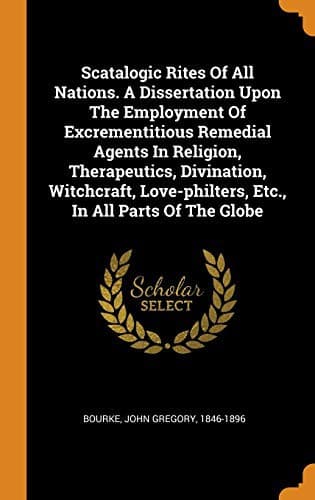
Scatalogic Rites of All Nations: A dissertation upon the employment of excrementitious remedial agents in religion, therapeutics, divination, witchcraft, love-philters, etc., in all parts of the globeBourke, John Gregory
Religion
Scatalogic Rites of All Nations: A dissertation upon the employment of excrementitious remedial agents in religion, therapeutics, divination, witchcraft, love-philters, etc., in all parts of the globe
Bourke, John Gregory
Scatology
Moreover, criminals executed for violations of the laws of conquering
nations, or for infractions of the discipline, or contempt of the
doctrines of a triumphant religion, might, by the conquered rustics,
who still cherished a half-concealed veneration for the old rulers and
supplanted rites, be looked upon as martyrs, whose bones, blood, and
crania would relieve disease and drive away misfortune.
The idea of sanctity, too, attached to “innocent maids and boys,” whose
undefiled blood might rectify the polluted fluid that coursed languidly
through the veins of the leper.
The belief that the gods are to be gratified and propitiated by the
spectacle of human suffering, especially when self-inflicted, has been
current from the first ages of the world, and will most probably last, in
one form or another, as long as the world shall last. It has cropped out
in every shape, from the rigorous abstinence of the ascetic to the brutal
flagellation of the fanatical devotee, and from that to the emasculation
of the Galli, the Khlysthi, and the Hottentot, and the self-immolation
of the servant of Juggernath. Maurice enumerates five different kinds of
meritorious suicide yet recognized in Hindostan, and we have no reason
for refusing to believe that our own ancestors were saturated with the
same false notions, which, retaining their hold upon the minds of an
illiterate peasantry, would surround with the mystery of holiness any act
of self-destruction attributable to mania or other impulse supposed to be
from on high.
BONES AND TEETH.—MARROW.
“If a circle is traced round an ulcer with a human bone, it will be
effectually prevented from spreading.”—(Pliny, lib. xxviii. c. 11.)
Etmuller believed that by the use of an unbroken human bone it was
possible to induce as copious a purgation as might be desired. “Beneficio
ossis humani integri potest fieri purgatio artificialis tanta quantum
volumus,” etc.—(Etmuller, vol. ii. p. 273.)
“‘Holy oyle of dead men’s bones,’ good for the ‘falling sickness.’”—(“The
Newe Jewell of Health,” George Baker, Chirurgeon, London, 1576, black
letter, p. 170.)
Beckherius prescribed human bones in medicine.—(See “Med. Microcos.,” p.
252 _et seq._)
Etmuller, not content with prescribing the bones ground into powder, also
directed the administration of human marrow (vol. ii. p. 268).
HUMAN TEETH.
“A tooth taken from a body before burial,” worn as an amulet, cured
toothache.—(Pliny, lib. xxviii. c. 12.)
“The first tooth that a child has shed,” worn as an amulet, protects from
pain in the uterus.—(Idem, lib. xxviii. c. 7.)
Pounded dead men’s teeth were used in fumigating the genitalia of persons
“ligated” by witchcraft.—(See Frommann, “Tract. de Fascin.,” p. 965.)
Public-domain text, read in full here on John Shaqi.
Reviews
Reviews
No reviews yet
Be the first to share your thoughts on this work.
Elsewhere in the archive
Join the Discussion
Join the discussion
Sign in to leave a comment or review.
Sign InorCreate an account