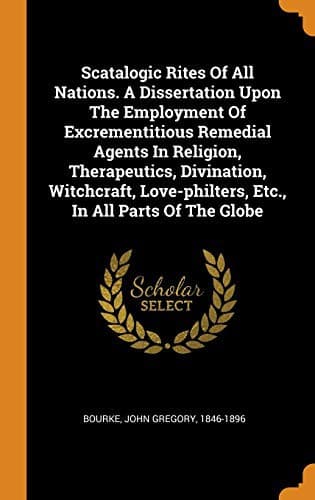
Scatalogic Rites of All Nations: A dissertation upon the employment of excrementitious remedial agents in religion, therapeutics, divination, witchcraft, love-philters, etc., in all parts of the globeBourke, John Gregory
Religion
Scatalogic Rites of All Nations: A dissertation upon the employment of excrementitious remedial agents in religion, therapeutics, divination, witchcraft, love-philters, etc., in all parts of the globe
Bourke, John Gregory
Scatology
For sacred intoxication among the Finns, see also “Chaldean Magic,”
Lenormant, p. 255, where there is a reference to “intoxicating drugs.”
XVI.
AN INQUIRY INTO THE DRUIDICAL USE OF THE MISTLETOE.
But the question at once presents itself, For what reason did the Celtic
Druids employ the much venerated mistletoe? This question becomes of deep
significance in the light of the learning shed by Godfrey Higgins and
General Vallencey upon the derivation of the Druids from Buddhistic or
Brahminical origin.
“Ajasson enumerates the following superstitions of ancient Britain, as
bearing probable marks of an Oriental origin: ... the ceremonials used
in cutting the plants.”—(“Mistletoe,” Pliny, Bohn, lib. 30, cap. 6,
footnote.)
That the mistletoe was regarded as a medicine, and a very potent one,
is easy enough to show. All the encyclopædias admit that much; but the
accounts that have been preserved of the ideas associated with this
worship are not complete or satisfactory.
“The mistletoe, which they (the Druids) called ‘all-heal,’ used to cure
disease.”—(McClintock and Strong’s Encyclopædia, quoting Stukeley.)
“The British bards and Druids had an extraordinary veneration for the
number three. ‘The mistletoe,’ says Vallencey, in his ‘Grammar of the
Irish Language,’ ‘was sacred to the Druids, because not only its berries,
but its leaves also, grow in clusters of three united to one stock. The
Christian Irish held the Seamroy sacred in like manner, because of three
leaves united to one stock.’”—(Brand, “Popular Antiquities,” London,
1872, vol. i, p. 109, article “St. Patrick’s Day.”)
“Within recent times the mistletoe has been regarded as a valuable remedy
in epilepsy (query, on the principle of _similia similibus_?) and other
diseases, but at present is not employed.... The leaves have been fed to
sheep in time of scarcity of other forage (which shows at least that it
is edible).”—(Appleton’s American Encyclopædia.)
“Seems to possess no decided medical properties.”—(International
Encyclopædia.)
“It is now perhaps impossible to account for the veneration in which
it was held and the wonderful qualities which it was supposed to
possess.”—(“The Druids,” Rev. Richard Smiddy, Dublin, 1871, p. 90.)
Pliny mentions three varieties. Of these “the hyphar is useful for
fattening cattle, if they are hardy enough to withstand the purgative
effect it produces at first; the viscum is medicinally of value as an
emollient, and in cases of tumors, ulcers, and the like.”
Pliny is also quoted as saying that it was considered of benefit to
women in childbirth,—“in conceptum feminarum adjuvare si omnino secum
habeant.”[26] Pliny is also authority for the reverence in which the
mistletoe growing on the robur (Spanish _roble_, or evergreen oak)
was held by the Druids. The robur, he says, is their sacred tree, and
whatever is found growing upon it, they regard as sent from heaven and as
the mark of a tree chosen by God.—(Encyclopædia Britannica.)
Public-domain text, read in full here on John Shaqi.
Reviews
Reviews
No reviews yet
Be the first to share your thoughts on this work.
Elsewhere in the archive
Join the Discussion
Join the discussion
Sign in to leave a comment or review.
Sign InorCreate an account