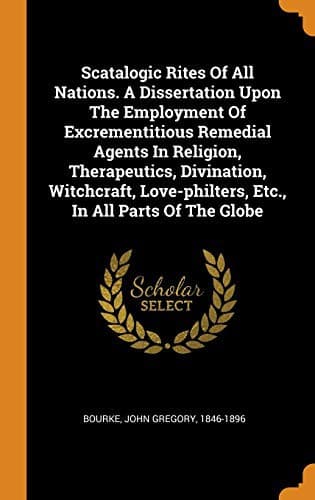
Scatalogic Rites of All Nations: A dissertation upon the employment of excrementitious remedial agents in religion, therapeutics, divination, witchcraft, love-philters, etc., in all parts of the globeBourke, John Gregory
Religion
Scatalogic Rites of All Nations: A dissertation upon the employment of excrementitious remedial agents in religion, therapeutics, divination, witchcraft, love-philters, etc., in all parts of the globe
Bourke, John Gregory
Scatology
Borlase sees much similarity between the Magi and our Druids, and Strabo
did the same. “Both carried in their hands, during the celebration of
their rites, a bunch of plants; that of the Magi was of course the Hom,
called Barsom,—Assyrian and Persepolis sculptures substantiate this. The
Hom looks very much like the Mistletoe, and the learned Dr. Stukeley
thinks that this parasite is meant as being on the tree mentioned by
Isaiah, vi. 13.”—(“Rivers of Life,” Forlong, vol. i. p. 43.)
“But yet it shall be a tenth, and it shall return and shall be eaten; as
a teil tree and as an oak, whose substance is in them, when they cast
their leaves; so the holy seed shall be the substance thereof.”—(Isaiah,
vi. 13.)
“The mistletoe wreath marks in one sense Venus’s temple, for any girl
may be kissed if caught under its sprays,—a practice, though modified,
which recalls to us that horrid one mentioned by Herodotus, where all
women were for once at least the property of the man who sought them in
Mylitta’s temple.”—(“Rivers of Life,” Forlong, London, 1883, vol. i. p.
91.)
The following are Frazer’s views on this subject: “The mistletoe was
viewed as the seat of life of the oak. The conception of the mistletoe
as the seat of life of the oak would naturally be suggested to primitive
people by the observation that while the oak is deciduous, the mistletoe
which grows on it is evergreen. In winter, the sight of its fresh foliage
among the bare branches must have been hailed by the worshippers of the
tree as a sign that the divine life which had ceased to animate the
branches yet survived in the mistletoe, as the heart of the sleeper still
beats when his body is motionless. Hence, when the god had to be killed,
when the sacred tree had to be burnt, it was necessary to begin by
breaking off the mistletoe, for so long as the mistletoe remained intact,
the oak (so people thought) was invulnerable,—all the blows of their
knives and axes would glance harmless from its surface. But once tear
from the oak its sacred heart, the mistletoe, and the tree nodded to its
fall.”—(“The Golden Bough,” James G. Frazer, M. A., London, 1890, vol.
ii. pp. 295, 296.)
This train of reasoning would be irrefutable, as it is most logical, were
we in a position to be able to say that the excision of the fungus was
followed by the felling of the tree; but, unfortunately, that is just
what we are not able to determine. As a surmise, there is no impropriety
in believing that such excision may have marked the oak for destruction
at some future day; but there is no authority that we can produce at this
time to justify anything more than a surmise in the premises. That the
sacred character of the oak was due to the properties discovered in the
mistletoe is quite likely in view of all the facts already presented.
Public-domain text, read in full here on John Shaqi.
Reviews
Reviews
No reviews yet
Be the first to share your thoughts on this work.
Elsewhere in the archive
Join the Discussion
Join the discussion
Sign in to leave a comment or review.
Sign InorCreate an account