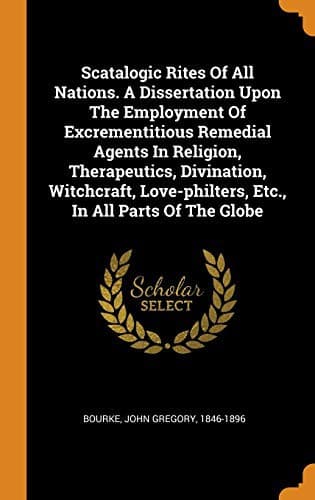
Scatalogic Rites of All Nations: A dissertation upon the employment of excrementitious remedial agents in religion, therapeutics, divination, witchcraft, love-philters, etc., in all parts of the globeBourke, John Gregory
Religion
Scatalogic Rites of All Nations: A dissertation upon the employment of excrementitious remedial agents in religion, therapeutics, divination, witchcraft, love-philters, etc., in all parts of the globe
Bourke, John Gregory
Scatology
And still another (in 2d series, vol. vi. p. 523) recognizes that “the
mistletoe was sacred to the heathen Goddess of Beauty,” and “it is
certain that the mistletoe, though it formerly had a place among the
evergreens employed in the Christian decorations, was subsequently
excluded.” This exclusion he accounts for thus: “It is also certain that,
in the earlier ages of the church, many festivities not at all tending
to edification (the practice of mutual kissing among the rest) had
gradually crept in and established themselves, so that, at a certain part
of the service, ‘statim clerus, ipseque populus per basia blande sese
invicim oscularetur.’”
This author cites Hone, Hook, Moroni, Bescherelle, Ducange, and others.
Finally (in the 3d series, vol. vii. p. 76), an inquirer asks, “How came
it in Shakspeare’s time to be considered ‘baleful,’ and, in our days,
the most mirth-provoking of plants?” And still another correspondent, in
the same series (vol. vii. p. 237), claims that “mistletoe will produce
abortion in the female of the deer or dog.”
“Sir John Ollbach, in his dissertation concerning mistletoe, which
he strongly recommends as a medicine very likely to subdue not only
the epilepsy, but all other convulsive disorders, observes that this
beautiful plant must have been designed by the Almighty for other
and more noble purposes than barely to feed thrushes or to be hung
up superstitiously in houses to drive away evil spirits. He tells
(p. 12) that ‘the high veneration in which the Druids were anciently
held by the people of all ranks proceeded in a great measure from the
wonderful cures they wrought by means of the mistletoe of the oak;
this tree being sacred to them, but none so that had not the mistletoe
upon them.’ Mr. F. Williams, dating from Pembroke, Jan. 28, 1791,
tells us, in the ‘Gentleman’s Magazine’ for February that year, that
‘“Guidhel,” mistletoe, a magical shrub, appeared to be the forbidden
tree in the middle of the trees of Eden; for, in the Edda, the mistletoe
is said to be Balder’s death, who yet perished through blindness and a
woman.’”—(Brand, “Popular Antiquities,” London, 1872, vol. i. p. 519,
article “Evergreen-decking at Christmas.”)
FORMER EMPLOYMENT OF AN INFUSION OR DECOCTION OF MISTLETOE.
That an infusion or decoction of the plant was once in use may be
gathered from the fact narrated by John Eliot Howard: “Water, in which
the sacred mistletoe had been immersed, was given to or sprinkled upon
the people.”—(“The Druids and their Religion,” John Eliot Howard, in
“Transactions of Victoria Institute,” vol. xiv. p. 118, quoting “Le gui
de chêne et les Druides,” E. Magdaleine, Paris, 1877.)
Montfaucon says of the Druids: “Ils croient que les animaux stériles
deviennent féconds en buvant de l’eau de gui.”—(“L’antiquité Expliquée,
Paris, 1722, tome 2, part 2, p. 436, quoting and translating Pliny.)
Public-domain text, read in full here on John Shaqi.
Reviews
Reviews
No reviews yet
Be the first to share your thoughts on this work.
Elsewhere in the archive
Join the Discussion
Join the discussion
Sign in to leave a comment or review.
Sign InorCreate an account