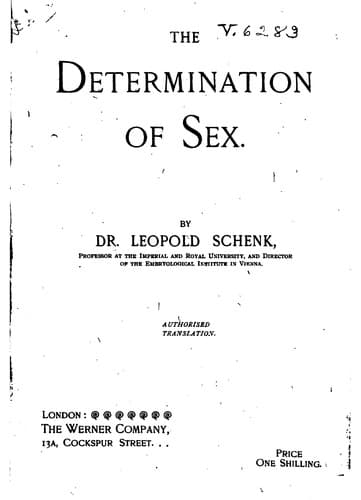
Schenk's Theory: The Determination of SexSchenk, Samuel Leopold
Science
Schenk's Theory: The Determination of Sex
Schenk, Samuel Leopold
Sex determination, Genetic; Sex preselection
In consequence of the influence which the altered diet, if commenced a
sufficiently long time before conception, exerts both over the mother
and over the ovum which is being prepared for fertilization, it is
possible that this ovum may develop itself into a male individual.
It also sometimes happens that, even with careful dieting, the
conditions which are necessary for our purpose are not realized--viz.:
that the sugar does not disappear from the urine, that the mother
cannot accommodate herself to a diet of the kind required. She finds
the situation intolerable, because she cannot do without an abundance
of starchy substances and sugar, and in consequence all hope of a
satisfactory result falls to the ground.
There are persons who from their youth upwards have lived principally
on vegetable food, and are therefore not accustomed to take the
nitrogenous substances of their diet in the concentrated form in
which they are presented in the albuminous constituent of meat. They
obtain the necessary nitrogen for the body from large amounts of food
containing a great quantity of water, and it may happen that they
cannot easily submit themselves to such a change of diet without
pernicious consequences. To this class belong the women who live in the
rural districts of many of the mountainous regions of central Europe,
where little flesh is eaten. With them it might often be a difficult
matter to make an abrupt change of diet of the desired kind. Such
individuals can be reconciled to the kind of diet we recommend only by
a gradual advance in the quantity of concentrated nitrogenous food. But
in such cases it might very likely prove possible to attain our end by
a corresponding vegetable diet.
* * * * *
The following case, which was conducted under my control with the
greatest care, and was also a case of an intelligent woman, who showed
the greatest willingness to do anything, in order that she might have
male offspring, is of the highest interest for our theory.
This woman was of a family in which principally female children had
been born. Although all its members were fruitful, no great number
of descendants seemed to have been reached. It is not unlikely that
the multiplication of descendants was restrained. The existence of a
tendency to provide female ova for fertilization was also proved by
testing the urine for sugar.
In the case of this woman, who wished to have male offspring, the
examination of the urine each time showed, as with the other women of
the family, traces of sugar. With her ordinary diet sugar was found
in the urine (that of twenty-four hours being collected) in minute
quantities. The unoxidized minute traces of sugar signified imperfect
combustion.
Public-domain text, read in full here on John Shaqi.
Reviews
Reviews
No reviews yet
Be the first to share your thoughts on this work.
Elsewhere in the archive
Join the Discussion
Join the discussion
Sign in to leave a comment or review.
Sign InorCreate an account