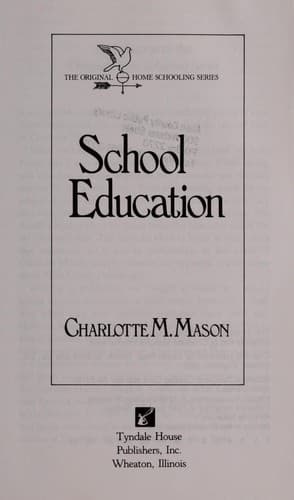
School educationMason, Charlotte M. (Charlotte Maria)
Philosophy
School education
Mason, Charlotte M. (Charlotte Maria)
Education -- Curricula; Education -- Philosophy
Every child has a right of entry to several fields of knowledge.
Every normal child has an appetite for such knowledge.
This appetite or desire for knowledge is a sufficient stimulus for all
school work, if the knowledge be fitly given.
There are four means of destroying the desire for knowledge:—
(_a_) Too many oral lessons, which offer knowledge in a diluted
form, and do not leave the child free to deal with it.
(_b_) Lectures, for which the teacher collects, arranges, and
illustrates matter from various sources; these often offer
knowledge in too condensed and ready prepared a form.
(_c_) Text-books compressed and re-compressed from the big book
of the big man.
(_d_) The use of emulation and ambition as incentives to
learning in place of the adequate desire for, and delight in,
knowledge.
Children can be most fitly educated on _Things_ and _Books_. Things,
_e.g._:—
i. Natural obstacles for physical contention, climbing,
swimming, walking, etc.
ii. Material to work in—wood, leather, clay, etc.
iii. Natural objects _in situ_—birds, plants, streams, stones,
etc.
iv. Objects of art.
v. Scientific apparatus, etc.
The value of this education by _Things_ is receiving wide recognition,
but intellectual education to be derived from _Books_ is still for the
most part to seek.
Every scholar of six years old and upwards should study with ‘delight’
_his own, living_, books on every subject in a pretty wide curriculum.
Children between six and eight must for the most part have their books
read to them.
This plan has been tried with happy results for the last twelve years in
many home schoolrooms, and some other schools.
By means of the free use of books the mechanical difficulties of
education—reading, spelling, composition, etc.—disappear, and studies
prove themselves to be ‘for delight, for ornament, and for ability.’
There is reason to believe that these principles are workable in all
schools, Elementary and Secondary; that they tend in the working to
simplification, economy, and discipline.
CHAPTER XX
SUGGESTIONS TOWARDS A CURRICULUM
(_For Children under Fourteen_)
PART I
=Summary of Preceding Chapters.=—I have left the consideration of a
curriculum, which is, practically, the subject of this volume, till the
final chapters; because a curriculum is not an independent product,
but is linked to much else by chains of cause and consequence. The
fundamental principles of docility and authority have been considered
in the first place because they _are_ fundamental; but, for that very
reason, they should be present but not in evidence; we do not expose
the foundations of our house. Not only so, but these principles must be
conditioned by respect for the personality of children; and, in order to
give children room for free development on the lines proper to them, it
is well that parents and teachers should adopt an attitude of masterly
inactivity.
Public-domain text, read in full here on John Shaqi.
Reviews
Reviews
No reviews yet
Be the first to share your thoughts on this work.
Elsewhere in the archive
Join the Discussion
Join the discussion
Sign in to leave a comment or review.
Sign InorCreate an account