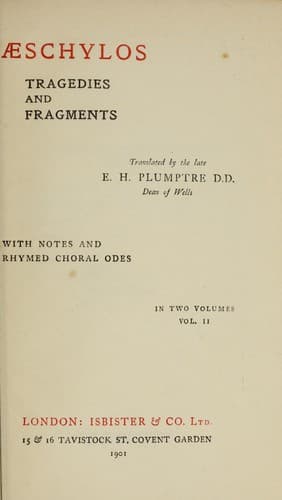
Aeschylus -- Translations into English; Mythology, Greek -- Drama
_Chor._ What evil thing, O Queen, or reared on earth,
Or draught from salt sea-wave 1380
Hast thou fed on, to bring
Such incense on thyself,[385]
A people's loud-voiced curse?
'Twas thou did'st sentence him,
'Twas thou did'st strike him down;
But thou shall exiled be,
Hated with strong hate of the citizens.
_Clytæm._ Ha! now on me thou lay'st the exile's doom,
My subjects' hate, and people's loud-voiced curse,
Though ne'er did'st thou oppose my husband there,
Who, with no more regard than had been due
To a brute's death, although he called his own
Full many a fleecy sheep in pastures bred,
Yet sacrificed his child, the dear-loved fruit 1390
Of all my travail-pangs, to be a charm
Against the winds of Thrakia. Shouldst thou not
Have banished him from out this land of ours,
As meed for all his crimes? Yet hearing now
My deeds, thou art a judge full stern. But I
Tell thee to speak thy threats, as knowing well
I am prepared that thou on equal terms
Should'st rule, if thou dost conquer. But if God
Should otherwise decree, then thou shall learn,
Late though it be, the lesson to be wise.
ANTISTROPHE
_Chor._ Yea, thou art stout of heart, and speak'st big words;1400
And maddened is thy soul
As by a murderous hate;
And still upon thy brow
Is seen, not yet avenged,
The stain of blood-spot foul;
And yet it needs must be,
One day thou, reft of friends,
Shall pay the penalty of blow for blow.
_Clytæm._ Now hear thou too my oaths of solemn dread:
By my accomplished vengeance for my child,
By Atè and Erinnys, unto whom
I slew him as a victim, I look not
That fear should come beneath this roof of mine,
So long as on my hearth Ægisthos kindles 1410
The flaming fire, as well disposed to me
As he hath been aforetime. He to us
Is no slight shield of stoutest confidence.
There lies he, [_pointing to the corpse of_ AGAMEMNON,] one who foully
wronged his wife,
The darling of the Chryseïds at Troïa;
And there [_pointing to_ CASSANDRA] this captive slave, this auguress,
His concubine, this seeress trustworthy,
*Who shared his bed, and yet was as well known
To the sailors as their benches!... They have fared
Not otherwise than they deserved: for he
Lies as you see. And she who, like a swan,[386]
Has chanted out her last and dying song, 1420
Lies close to him she loved, and so has brought
The zest of a new pleasure to my bed.
STROPHE I[387]
Public-domain text, read in full here on John Shaqi.
Reviews
Reviews
No reviews yet
Be the first to share your thoughts on this work.
Elsewhere in the archive
Join the Discussion
Join the discussion
Sign in to leave a comment or review.
Sign InorCreate an account