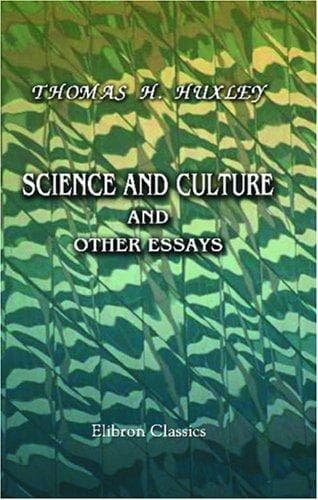
Science and Culture, and Other EssaysHuxley, Thomas Henry
Philosophy
Science and Culture, and Other Essays
Huxley, Thomas Henry
Science
Of all the dangerous mental habits, that which schoolboys call
“cocksureness” is probably the most perilous; and the inestimable
value of metaphysical discipline is that it furnishes an effectual
counterpoise to this evil proclivity. Whoso has mastered the elements
of philosophy knows that the attribute of unquestionable certainty
appertains only to the existence of a state of consciousness so long
as it exists; all other beliefs are mere probabilities of a higher or
lower order. Sound metaphysic is an amulet which renders its possessor
proof alike against the poison of superstition and the counter-poison
of nihilism; by showing that the affirmations of the former and the
denials of the latter alike deal with matters about which, for lack of
evidence, nothing can be either affirmed or denied.
I have dwelt at length upon the nature and origin of our sensations of
smell, on account of the comparative freedom of the olfactory sense
from the complications which are met with in most of the other senses.
Sensations of taste, however, are generated in almost as simple a
fashion as those of smell. In this case, the sense organ is the
epithelium which covers the tongue and the palate: and which sometimes,
becoming modified, gives rise to peculiar organs termed “gustatory
bulbs,” in which the epithelial cells elongate and assume a somewhat
rod-like form. Nerve fibres connect the sensory organ with the
sensorium, and tastes or flavours are states of consciousness caused
by the change of molecular state of the latter. In the case of the
sense of touch there is often no sense organ distinct from the general
epidermis. But many fishes and amphibia exhibit local modifications
of the epidermic cells which are sometimes extraordinarily like the
gustatory bulbs; more commonly, both in lower and higher animals,
the effect of the contact of external bodies is intensified by the
development of hair-like filaments, or of true hairs, the bases of
which are in immediate relation with the ends of the sensory nerves.
Every one must have noticed the extreme delicacy of the sensations
produced by the contact of bodies with the ends of the hairs of the
head; and the “whiskers” of cats owe their functional importance to
the abundant supply of nerves to the follicles in which their bases
are lodged. What part, if any, the so-called “tactile corpuscles,”
“end bulbs,” and “Pacinian bodies,” play in the mechanism of touch is
unknown. If they are sense organs, they are exceptional in character,
in so far as they do not appear to be modifications of the epidermis.
Nothing is known respecting the organs of those sensations of
resistance which are grouped under the head of the muscular sense;
nor of the sensations of warmth and cold; nor of that very singular
sensation which we call tickling.
Public-domain text, read in full here on John Shaqi.
Reviews
Reviews
No reviews yet
Be the first to share your thoughts on this work.
Elsewhere in the archive
Join the Discussion
Join the discussion
Sign in to leave a comment or review.
Sign InorCreate an account