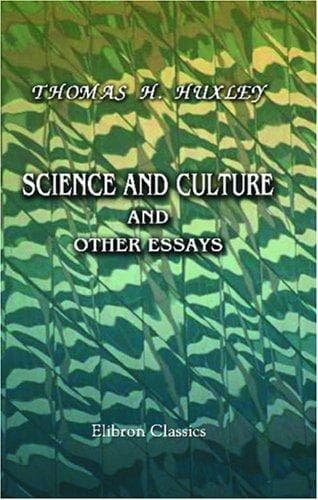
Science and Culture, and Other EssaysHuxley, Thomas Henry
Philosophy
Science and Culture, and Other Essays
Huxley, Thomas Henry
Science
No amount of physiological reasoning could enable any one to say
whether the animal which fabricated the Belemnite was more like
_Nautilus_, or more like _Spirula_. But the accidental discovery of
Belemnites in due connection with black elongated masses which were
certainly fossilised ink-bags, inasmuch as the ink could be ground up
and used for painting as well as if it were recent sepia, settled the
question; and it became perfectly safe to prophesy that the creature
which fabricated the Belemnite was a two-gilled cephalopod with suckers
on its arms, and with all the other essential features of our living
squids, cuttle-fishes, and _Spirulæ_. The palæontologist was, by this
time, able to speak as confidently about the animal of the Belemnite,
as Zadig was respecting the queen’s spaniel. He could give a very fair
description of its external appearance, and even enter pretty fully
into the details of its internal organisation, and yet could declare
that neither he, nor any one else, had ever seen one. And as the
queen’s spaniel was found, so happily has the animal of the Belemnite;
a few exceptionally preserved specimens having been discovered, which
completely verify the retrospective prophecy of those who interpreted
the facts of the case by due application of the method of Zadig.
These Belemnites flourished in prodigious abundance in the seas of the
mesozoic or secondary age of the world’s geological history; but no
trace of them has been found in any of the tertiary deposits, and they
appear to have died out towards the close of the mesozoic epoch. The
method of Zadig, therefore, applies in full force to the events of a
period which is immeasurably remote, which long preceded the origin
of the most conspicuous mountain masses of the present world, and
the deposition, at the bottom of the ocean, of the rocks which form
the greater part of the soil of our present continents. The Euphrates
itself, at the mouth of which Oannes landed, is a thing of yesterday
compared with a Belemnite; and even the liberal chronology of Magian
cosmogony fixes the beginning of the world only at a time when other
applications of Zadig’s method afford convincing evidence that, could
we have been there to see, things would have looked very much as they
do now. Truly the magi were wise in their generation; they foresaw
rightly that this pestilent application of the principles of common
sense, inaugurated by Zadig, would be their ruin.
But it may be said that the method of Zadig, which is simple reasoning
from analogy, does not account for the most striking feats of modern
palæontology—the reconstruction of entire animals from a tooth or
perhaps a fragment of a bone; and it may be justly urged that Cuvier,
the great master of this kind of investigation, gave a very different
account of the process which yielded such remarkable results.
Public-domain text, read in full here on John Shaqi.
Reviews
Reviews
No reviews yet
Be the first to share your thoughts on this work.
Elsewhere in the archive
Join the Discussion
Join the discussion
Sign in to leave a comment or review.
Sign InorCreate an account