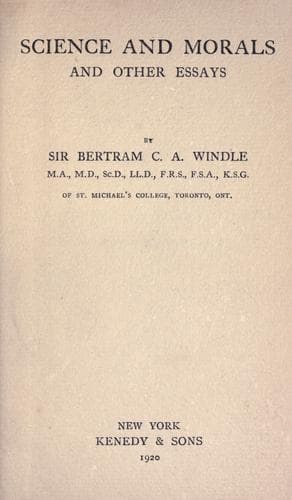
Science and Morals and Other EssaysWindle, Bertram Coghill Alan, Sir
Religion
Science and Morals and Other Essays
Windle, Bertram Coghill Alan, Sir
Essays; Religion and science; Science
As Father Hull says, "the new view gradually filtered down
from learned circles to the man in the street, so that nowadays the
partiality of the Deluge is a matter of commonplace knowledge among all
educated Christians, and is even taught to the rising generation in
elementary schools."
In accordance with the wise provisions of the Encyclical
_Providentissimus Deus_, with which all educated Catholics should make
themselves familiar, conflicts have been avoided on this, and on other
points, such as the general theory of evolution and the various problems
connected with it; the antiquity of man upon the earth and other
matters as to which science is still uncertain. Some of these points
might seem to conflict with the Bible and the teachings of the Church.
As Catholics we can rest assured that the true explanation, whenever it
emerges, cannot be opposed to the considered teaching of the Church.
What the Church does--and surely it must be clear that from her
standpoint she could not do less--is to instruct Catholic men of science
not to proclaim _as proved facts_ such modern theories--and there are
many of them--as still remain wholly unproved, when these theories are
such as might seem to conflict with the teaching of the Church. This is
very far from saying that Catholics are forbidden to study such
theories.
On the contrary, they are encouraged to do so, and that, need it be
said, with the one idea of ascertaining the truth? Men of science,
Catholic and otherwise, have, as a mere matter of fact, been time and
again encouraged by Popes and other ecclesiastical authorities to go on
searching for the truth, never, however, neglecting the wise maxim that
all things must be proved. So long as a theory is unproved, it must be
candidly admitted that it is a crime against science to proclaim it to
be incontrovertible truth, yet this crime is being committed every day.
It is really against it that the _magisterium_ of the Church is
exercised. The wholesome discipline which she exercises might also be
exercised to the great benefit of the ordinary reading public by some
central scientific authority, can such be imagined, endowed with the
right to say (and in any way likely to be listened to): "Such and such a
statement is interesting--even extremely interesting--but so far one
must admit that no sufficient proof is forthcoming to establish it as a
fact: it ought not, therefore, to be spoken of as other than a theory,
nor proclaimed as fact."
Such constraint when rightly regarded is not or would not be a shackling
of the human intellect, but a kindly and intelligent guidance of those
unable to form a proper conclusion themselves. Such is the idea of the
Church in the matter with which we have been dealing.
FOOTNOTES:
[Footnote 23: _Darwiniana_, p. 147.]
[Footnote 24: See, for example, his _Life and Letters_,
i., 307.]
[Footnote 25: _Hume_, _English Men of Letters Series_, p. 135.]
Public-domain text, read in full here on John Shaqi.
Reviews
Reviews
No reviews yet
Be the first to share your thoughts on this work.
Join the Discussion
Join the discussion
Sign in to leave a comment or review.
Sign InorCreate an account