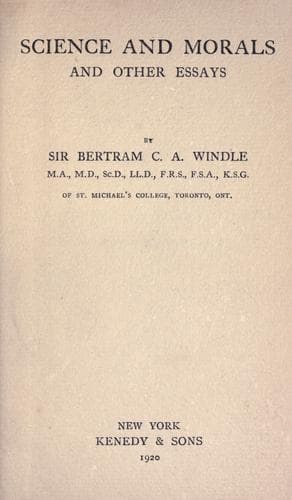
Science and Morals and Other EssaysWindle, Bertram Coghill Alan, Sir
Religion
Science and Morals and Other Essays
Windle, Bertram Coghill Alan, Sir
Essays; Religion and science; Science
[Footnote 26: Of course, it may be argued, no Fellow need have
applied for an _imprimatur_; he did it _ex majori cantela_ as
the lawyers say. This may be so, but the same applies to the
ecclesiastical _imprimatur_.]
[Footnote 27: The review from which the following quotations
are made appeared in _Nature_ on January 24, 1889.]
[Footnote 28: Vol. ii., p. 113.]
[Footnote 29: _Galileo and His Condemnation_, Catholic Truth
Society of England.]
V. SCIENCE AND THE WAR
Amongst various important matters now brought to a sharper focus in the
public eye, few, if any, require more careful attention than that which
is concerned with science, its value, its position, its teachings, and
how it should be taught. No one who has followed the domestic
difficulties due to our neglect of the warnings of scientific men can
fail to see how we have had to suffer because of the lax conduct of
those responsible for these things in the past.
Within the first few weeks after the war broke out--to take one
example--every medical man was the recipient of a document telling him
of the expected shortage in a number of important drugs and suggesting
the substitutes which he might employ. It was a timely warning; but it
need never have been issued if we had not allowed the manufacture of
drugs, and especially those of the so-called "synthetic" group, to drift
almost entirely into the hands of the Badische Aniline Fabrik, and
kindred firms in Germany. This difficulty, now partly overcome, is one
which never would have arisen but for the deaf ear turned to the
warnings of the scientific chemists. British pharmaceutical chemists,
with one or two exceptions, had been relying upon foreign sources not
only for synthetic drugs but actually for the raw materials of many of
their preparations--such, for example, as aconite, belladonna, henbane,
all of which can be freely grown--which even grow wild--in these
islands; even, incredible as it may seem, for foxglove leaves. These
things with many others were imported from Germany and Austria. Here
again leeway has had to be made up; but it ought never to have been
necessary, and now that the war is over steps should be taken to see
that it never need be necessary again. The encouragement of British
herb-gardens and of scientific experiment therein on the best method of
culture for the raw material of our organic medicines must certainly be
matters early taken in hand.
The classical example of the mortal injury done to British manufacture
by the British manufacturer's former contempt for the scientific man is
that of the aniline dyes, which are so closely associated with the
synthetic drugs as to form one subject of discussion. Quite early in the
war dye-stuffs ran short, and there was no means of replenishing the
stock in Britain, nor even in America, these products having formed the
staple of a colossal manufacture, with an enormous financial turnover,
in Germany.
Public-domain text, read in full here on John Shaqi.
Reviews
Reviews
No reviews yet
Be the first to share your thoughts on this work.
Elsewhere in the archive
Join the Discussion
Join the discussion
Sign in to leave a comment or review.
Sign InorCreate an account