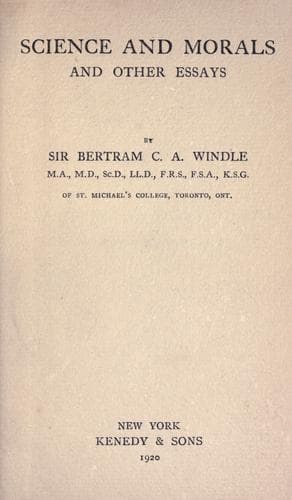
Science and Morals and Other EssaysWindle, Bertram Coghill Alan, Sir
Religion
Science and Morals and Other Essays
Windle, Bertram Coghill Alan, Sir
Essays; Religion and science; Science
Perhaps this is not to be wondered at; for Parliament always contains
many lawyers, and at the moment, I think, not a single scientific
expert, at least among the Commons. This is not really a sordid
argument, though it may appear so. The labourer, after all, is worthy of
his hire; but in the scientific world it very, very seldom happens that
the hire is worthy of the labourer. Even to this day there is plenty of
truth in the description of the attitude of Mr. Meagles towards Mr.
Doyce as detailed by the author of _Little Dorrit_. Perhaps that is
partly because it is generally the man of business, and not the unhappy
man of science, who gains the money produced by scientific discoveries.
These are often, if not usually, made by accident, and by a man on the
track of something else, on the elucidation of which he is probably so
intent that he cannot spare time for side-issues, very likely never even
thinks of them. Sir James Dewar discovered the principle of the "Thermos
flask" whilst he was working at the exceedingly difficult subject of the
liquefaction of air. I hope Sir James had the prescience to patent his
discovery, and reap the reward which was due to him; but, if he did, he
is one amongst a thousand who never took this trouble and of whom _Sic
vos non vobis_ might well be said. When Sabatier had shown the
importance of combinations of hydrogen effected by what is known as a
catalyst, numerous patents were taken out--by other people, of
course--on which were founded very flourishing businesses. Sabatier
profited by none of these--so I understand. He received a Nobel prize
for his discoveries; but another hath his heritage.
Though science has not received any great encouragement, yet in spite of
that--the cynic might say because of that--it has made amazing progress
during the past half-century. Mr. Chesterton somewhere notes that "a
time may easily come when we shall see the great outburst of science in
the Nineteenth Century as something quite as splendid, brief, unique,
and ultimately abandoned as the outburst of art at the Renaissance."
That, of course, may be so, but as to the outburst there can be no
question, nor of its persistence to the present day. That also is surely
a curious phenomenon; for, as regards most other things, we seem to be
in the trough of the wave, and not merely in these islands but all over
the civilised world. In Art, in Music, in Literature, in the Drama, it
would be difficult to argue in favour of a pre-eminence, or even of an
equality of the present age, comparing it with its predecessors.
Public-domain text, read in full here on John Shaqi.
Reviews
Reviews
No reviews yet
Be the first to share your thoughts on this work.
Elsewhere in the archive
Join the Discussion
Join the discussion
Sign in to leave a comment or review.
Sign InorCreate an account