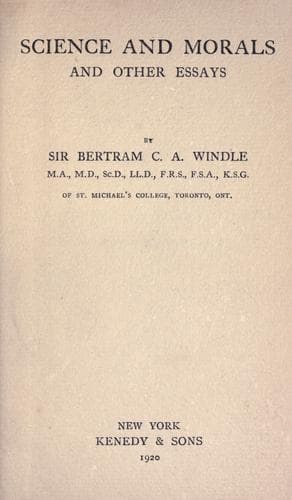
Science and Morals and Other EssaysWindle, Bertram Coghill Alan, Sir
Religion
Science and Morals and Other Essays
Windle, Bertram Coghill Alan, Sir
Essays; Religion and science; Science
Take the politicians of the world; it is perhaps difficult, even
foolish, for us who are living with them to prophesy with any
approximation of accuracy what the historian of a future day may say
about them. He may sum them up as respectable, honest mediocrities
trying to do their best under exceptionally difficult circumstances; he
may put them lower; he may put them higher; he may differentiate between
those of different nations; but there is little doubt that, with the
exception of the American President, he will not be able to point to any
one of the calibre of Pitt or of Bismarck or of the less severely tried
Disraeli or Gladstone.
But just the reverse is the case in science, which has men of the very
first rank living, working, and discovering to-day. There are indeed
signs that even our Government is cognizant of this. The creation of a
Department of Industrial Scientific Research, the provision of a
substantial income for the same, the increase of research-grants to
learned societies, these and other things show that some attempt will be
made to recognise the value of science to the State. Further, the
lesson seems to have gone home to some few at least that there is no
difference between what have been absurdly called Pure and Applied
Science, since so very many "Applied" discoveries--such as the
"Thermos"--arose in the course of what certainly would have been
described as "Pure" researches.
It is to the public advantage that every educated person should know
something about science; nor is this by any means as big or difficult an
achievement as some may imagine. It is not necessary to teach any very
large number of persons very much about any particular science or group
of sciences. What is really important is that people should imbibe some
knowledge of scientific methods--of the meaning of science. This can be
done from the study of quite a few fundamental propositions of any one
science under a good teacher--a first essential. Any person thus
educated will, for the remainder of his life, be able at least to
understand what is meant by science and the scientific method of
approaching a problem. He will not, like an educational troglodyte at a
recent Conference, refuse to describe anything as science which is not
capable of mathematical treatment, nor allude compendiously to
physiological study as "the cutting up of frogs." In a word, he will be
an educated man, which can no more be said of one ignorant of science
than it can be of one whose mind has never experienced the softening
influence of letters.
Public-domain text, read in full here on John Shaqi.
Reviews
Reviews
No reviews yet
Be the first to share your thoughts on this work.
Elsewhere in the archive
Join the Discussion
Join the discussion
Sign in to leave a comment or review.
Sign InorCreate an account