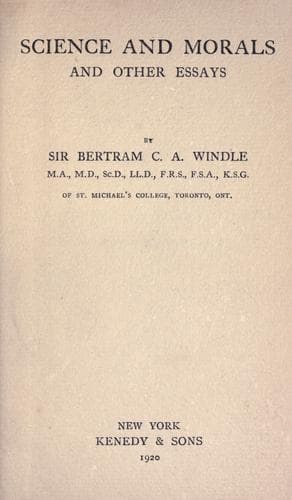
Science and Morals and Other EssaysWindle, Bertram Coghill Alan, Sir
Religion
Science and Morals and Other Essays
Windle, Bertram Coghill Alan, Sir
Essays; Religion and science; Science
If we pursue this question further we shall begin to remember that
creatures more nearly related to one another also "breed true." The hen
and the duck are both birds, but they are not so nearly allied to one
another as the lion and the tiger, both of which are _Felidae_, or cats.
Yet no one ever expects that a tiger will be born of a lioness, or _vice
versa_. Further, the pug and the greyhound are both of them dogs: the
name _canis domesticus_ applies to both, and one would be distinguished
from the other in a scientific list as "Var. (_i.e._ variety) 'pug,'" or
"Var. 'greyhound.'" Yet one can imagine the surprise of a breeder if a
greyhound was born in his carefully selected and guarded kennel of pugs.
In a word, not only species, but varieties do tend to breed true; the
child does resemble its parent or parents. No doubt the resemblance is
not absolute: there is variation as well as inheritance. Sometimes the
variation may be recognised as a feature possessed by a grandparent or
even by some collateral relative such as an uncle or great-uncle;
sometimes this may not be the case, though the non-recognition of the
likeness does not in any way preclude the possibility that the
peculiarity may have been also possessed by some other member of the
family. But on the whole the offspring does closely resemble its
parents; that is to say, not only the species and the variety but the
individual "breeds true." "Look like dey are bleedzed to take atter der
pa," as Uncle Remus said when he was explaining how the rabbit comes to
have a bobtail. Moreover this resemblance is not merely in the great
general features. Apart from monstrosities, the children of human beings
are human beings; the children of white parents have white skins, those
of black progenitors are black. Commonly, though not always by any
means, the children of dark-haired parents are themselves dark-haired,
and so on. But smaller features are also transmitted, and transmitted
too for many generations; for example, the well-known case of the
Hapsburg lip, visible in so many portraits of Spanish monarchs and their
near relatives, and visible in life to-day. Again, there are families in
which the inner part of one eyebrow has the hairs growing upwards
instead of in the ordinary way, a feature which is handed on from one
generation to another. Even more minute features than this have been
known to be transmissible and transmitted, such as a tiny pit in the
skin on the ear or on the face. In fact, there is hardly any feature, no
matter how small, which may not become a hereditary possession.
Public-domain text, read in full here on John Shaqi.
Reviews
Reviews
No reviews yet
Be the first to share your thoughts on this work.
Elsewhere in the archive
Join the Discussion
Join the discussion
Sign in to leave a comment or review.
Sign InorCreate an account