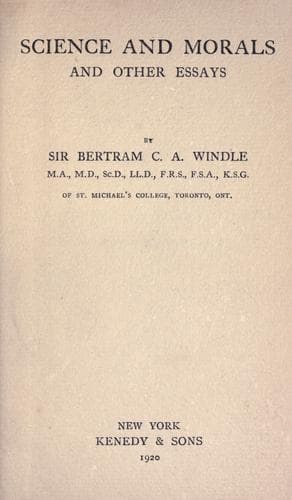
Science and Morals and Other EssaysWindle, Bertram Coghill Alan, Sir
Religion
Science and Morals and Other Essays
Windle, Bertram Coghill Alan, Sir
Essays; Religion and science; Science
On this analogy, many have suggested that every organ in the body--we
must go further, and say that every marked feature in every organ in the
body--is represented in the germ by a seed which can grow, under
favourable circumstances, into just such another organ or feature of an
organ. This was the theory put forward by Darwin under the name of
"pangenesis," and by others under other titles with which it is
unnecessary to burden these pages. All these theories have been summed
together under the name "micromeristic," that is small-fragmented, or
again, "particulate," since they all postulate the existence in the germ
of innumerable small fragments--seeds--which are capable of growing into
complete plants or organs under favourable circumstances. Again, this,
even if true, does not by any means exhaust the matter, for it does not
explain why the seed of the eye implants itself and grows in the right
place in the head instead of making a home for itself, let us say, in
the sole of the foot. But again we must pass over that matter.
There is nothing inherently impossible in this theory; indeed, if we
allow that the transmission of inheritable characteristics is purely
material, and it may be, there is only one other conceivable way in
which it can occur. It is true that the seeds must be almost
innumerable, but the germ, though small, is capable of accommodating an
almost innumerable number of independent factors, if the prevalent views
as to the constitution of matter are to be believed. And, as it is quite
inconceivable that we can ever have microscopes which could detect such
minute objects as the ultimate bricks of which the atom--no, not even
the atoms themselves which compose the germ--consists, it is impossible
that we should be able to say that the seed-theory is untrue. Even if we
could see these ultimate constituents it is in the last degree unlikely
that they would have any resemblance to the things which are, on this
theory to grow from them, any more than the acorn resembles the oak
which is to spring from it.
But observe! the germ on this view must contain not only seeds from the
immediate parents but from many, perhaps all, of the older generations
of the family, otherwise how are we to account for the appearance of
ancestral peculiarities which the father and mother do not show?
Moreover, since very minute things, like the inner angle of the eyebrow,
may independently vary, there must be an enormous number of seeds apart
altogether from the considerations alluded to in the last paragraph. And
many authorities who have closely considered the question have come to
the conclusion that the complexities introduced would be so great that
it is impossible to believe in any micromeristic theory.
Public-domain text, read in full here on John Shaqi.
Reviews
Reviews
No reviews yet
Be the first to share your thoughts on this work.
Elsewhere in the archive
Join the Discussion
Join the discussion
Sign in to leave a comment or review.
Sign InorCreate an account