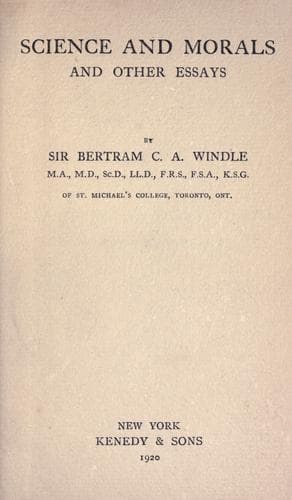
Science and Morals and Other EssaysWindle, Bertram Coghill Alan, Sir
Religion
Science and Morals and Other Essays
Windle, Bertram Coghill Alan, Sir
Essays; Religion and science; Science
is too lengthy a process for one man to carry out, he did in fact
discover that there are very definite laws, capable even of numerical
statement, under which inheritance acts. There is no need to explain or
discuss them here: suffice it to say that there _are_ such laws,[34] as
is now admitted by an overwhelming majority of the biologists of to-day.
Mendel's facts were hidden in a somewhat obscure journal; they lay
dormant, much to his annoyance, during his lifetime. Years after his
death his papers were unearthed, and his discoveries have been
proclaimed as being as fundamental to biology as those of Newton and
Dalton to other sciences.
There are, then, laws. That means one of two things: either that these
laws arose by chance-medley, or that some one enacted them. It seems
impossible, when one surveys the orderly operations of Nature, among
which are those conducted under the laws known by the name of their
discoverer, Mendel--it seems wholly impossible that these operations
arose by chance-medley. To me, at any rate, any such explanation is
wholly unthinkable. But if it be an impossible explanation, as I and
many thousands, not to say millions, of other persons believe, then
there is no other way out of it than that these operations must have
been planned by some one; in other words, that there must have been a
Creator and Deviser of the world.
People hide from this explanation, and one of the favourite sandbanks in
which this particular kind of human ostrich plunges its head is
"Nature." "Nature does this," and "Nature does that," forgetting
entirely the fact that "Nature" is a mere personification and means
either chance-medley or a Creator, according to the old dilemma. There
is a very curious example of this inability or unwillingness to
admit--perhaps even to understand--the force of this argument exhibited
by those to whom one would suppose that it would come home with
overpowering force: I mean, of course, the Mendelians.
The most learned of these, and one of the most open-minded of men,
hints in one place that though he does not think it necessary himself to
believe it, yet it might at least be suggested that, if in a certain
organism we find things so placed that a certain combination is bound to
emerge in a certain generation, such a state of affairs might have been
prearranged. Now, if it was prearranged, the awful fact emerges that
there must have been an arranger; in other words, a creative power. This
explanation is taboo in certain circles. But one may reasonably ask,
"What then?" Is it really suggested that these orderly sets of
occurrences may occur not once or twice only but thousands and thousands
of times, and this may all happen by chance? A very distant acquaintance
with the mathematics of probability will show that this is a wholly
untenable theory. We are generally answered by some purely verbal
explanation, like the personification of "Nature" already alluded to.
Public-domain text, read in full here on John Shaqi.
Reviews
Reviews
No reviews yet
Be the first to share your thoughts on this work.
Elsewhere in the archive
Join the Discussion
Join the discussion
Sign in to leave a comment or review.
Sign InorCreate an account