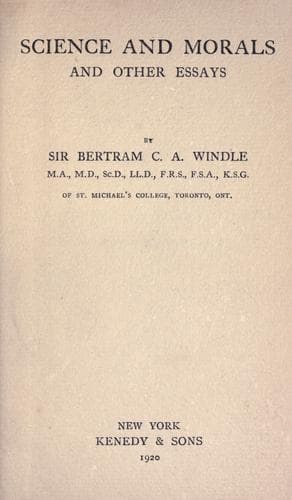
Science and Morals and Other EssaysWindle, Bertram Coghill Alan, Sir
Religion
Science and Morals and Other Essays
Windle, Bertram Coghill Alan, Sir
Essays; Religion and science; Science
If we go to the brain-case we can search it through and through without
finding a liver-cell, any more than we should find a typical brain-cell
embedded in the marrow of one of the bones. The different specimens all
occupy their appropriate positions. How did they get there? The future
animal, like animals of all kinds, including man, commences as a single
cell. All save a few interesting but at present negligible cases are
composed of elements drawn from male and female parents. This cell
divides up into a multitude of others. At first these are to all
appearances identical, but later they begin to differentiate, at first
into three classes and afterwards into the multitude of different cells
of which the body is composed. Further, these groups of cells become
aggregated in appropriate groups, cells of one kind uniting with cells
of the same kind and with no others. Here we have to do with
arrangement, consummately skilful arrangement, an arrangement which
practically never fails, for, leaving aside the case of monstrosity, a
consideration of which would detain us too long, not merely are the
various cells all placed in their proper positions, as we have seen, but
their aggregation, the individual, is so formed as to belong to the
proper compartment of that large museum, the world--the same compartment
as that occupied by his progenitors. Neither the particulate nor the
chemical theories help us here. The mnemic would, but it has its initial
and insuperable difficulty, pointed out in another article in this
volume, that, as you must have an experience before you can remember it,
it in no way accounts for the first operation of arrangement. As to the
material explanations, particulate or chemical, they amount to something
like this: you have half a cart-load of bricks from one yard and half a
cart-load from another, and when the bricks are dumped down in an
appropriate place they form a little house, just like those occupied by
the managers of the brickyards. So they may, but no one in his sense
supposes that they will thus arrange themselves of their own power.
Some one must arrange them. Who arranges the tiny bricks of which the
animal body consists, or what arranges them? To revert to our previous
example of the garden; suppose that we bring back from that which we
desire to copy a bag of seeds representing all the plants which it
contains. We have a plot of land of the same size as our example; we dig
it and we dung it and then we scatter our seeds perfectly haphazard over
its surface. What are the odds as to their coming up in an exactly
similar pattern to those in the other garden. Mathematicians, I suppose,
could calculate the probabilities, but they must be infinitesimally
small. Yet in the case of the animal the pattern is always observed.
Public-domain text, read in full here on John Shaqi.
Reviews
Reviews
No reviews yet
Be the first to share your thoughts on this work.
Elsewhere in the archive
Join the Discussion
Join the discussion
Sign in to leave a comment or review.
Sign InorCreate an account