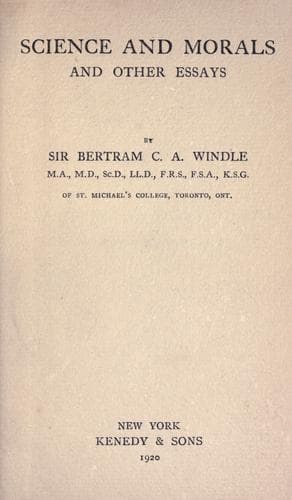
Science and Morals and Other EssaysWindle, Bertram Coghill Alan, Sir
Religion
Science and Morals and Other Essays
Windle, Bertram Coghill Alan, Sir
Essays; Religion and science; Science
And again, when dealing with the palaeontological evidence in favour of
evolution, he points out that Cuvier and Agassiz, examining it as it was
known in their day, interpreted the facts as the carrying out of a
systematic creative plan, an interpretation which the author claims "is
not at all invalidated by the acceptance of the evolutionary theory." He
is not, we need hardly say, in any way singular in taking up this
attitude, since it was held by Darwin, by Wallace, by Huxley, and by
other sturdy defenders of the doctrine of evolution.
Yet, just as at the time that Darwin's views were first made public,
many thought that they were subversive of Christianity, so, even now,
some whose acquaintance with the problem and its history is of a
superficial character, are inclined when they see the word creation,
even with the qualifying adjective "special" prefixed to it, used in
contradistinction to evolution, to imagine that the theory of creation,
and of course of a Creator, must fall to the ground if evolution should
be proved to be the true explanation of living things and their
diversities.
It is more than a little difficult for us, living at the present day, to
understand this curious frame of mind; yet it certainly existed, and
existed where it might least have been expected to exist. Nor is it
quite extinct to-day, though it only lingers in the less instructed
class of persons. The misconception arose from a confusion between the
fact and the method of creation. As to the former, no Catholic, no
Christian, no theist has any kind of doubt; indeed there are those who
could not be classified under any of those categories who still would be
prepared to admit that there must be a First Cause as the explanation
of the universe. Some of them, whose reasoning is a little difficult to
follow, seem to be content with an immanent, blind god, a mere
mainspring to the clock, making it move, no doubt, but otherwise
powerless. If we neglect--in a mathematical sense--those who adopt the
agnostic attitude; content themselves with the formula _ignoramus et
ignorabimus_ of Du Bois Reymond, and confine their investigations to the
machine as a going machine without inquiring how it came to be a machine
or what set it to work, we shall, I think, find that most people who
have really thought out the question admit that the only reasonable
explanation of things as they are, is the postulation of a Free First
Cause; in other words, an Omnipotent Creator of the universe. Such, of
course, is the teaching of the Scriptures and of the Church, and it must
be admitted that neither of them carries us very much further in this
matter. In fact, whilst both are perfectly clear and definite about the
fact of creation, neither of them has much to say about the method. Yet,
as all admit, evolution concerns only the method and tells us absolutely
nothing about the cause.
Public-domain text, read in full here on John Shaqi.
Reviews
Reviews
No reviews yet
Be the first to share your thoughts on this work.
Elsewhere in the archive
Join the Discussion
Join the discussion
Sign in to leave a comment or review.
Sign InorCreate an account